
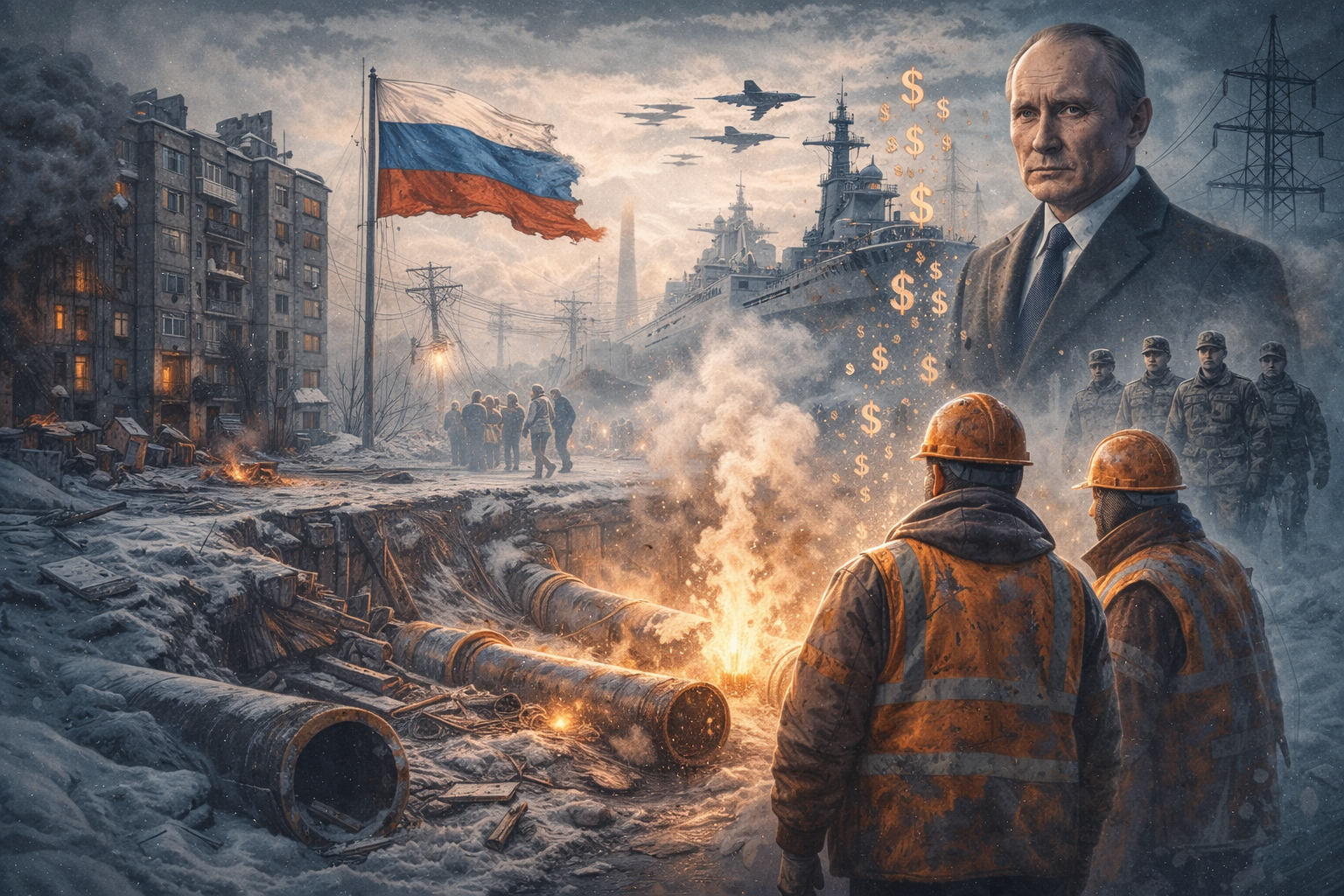
If you want a clean snapshot of what prolonged war does to a country, don’t start with tanks or front lines. Start with heating pipes.
Right now, a quiet but very real utilities breakdown is spreading across Russia. It isn’t sudden. It isn’t mysterious. And it isn’t happening because of one cold snap or one unlucky region. It’s happening because a system that was already worn thin is now being asked to survive on leftovers while enormous resources are redirected toward the war against Ukraine.
This is what structural stress looks like when it finally reaches the surface.
A problem years in the making
Russia’s utilities system has been aging for decades. Heating networks laid down in the Soviet era were designed with long service lives, but only if they were maintained, modernized, and gradually replaced. That didn’t happen.
Instead, repairs became reactive rather than preventative. Funding was inconsistent. Modernization projects were postponed. In many regions, local authorities learned to manage decline rather than fix it. Pipes ruptured, crews patched, and everyone hoped the next winter wouldn’t be worse than the last.
That approach worked only as long as the system had slack.
Now it doesn’t.
According to Russian state statistics acknowledged even before the full-scale invasion of Ukraine, roughly one-third of the country’s heating networks are already in critical condition. That number isn’t abstract. It means brittle metal, outdated control systems, and infrastructure that can no longer absorb shocks.
War didn’t create this weakness. It removed the buffer that kept it hidden.
When fixes stretch from hours to weeks
What’s changing now isn’t just the number of breakdowns. It’s how long they last.
In past winters, ruptured heating lines were often repaired within hours or days. Crews were available. Spare parts could be sourced. Emergency funds existed. Today, similar failures are dragging on for weeks.
A clear example is the settlement of Atamanovka in Zabaykalsky Krai. Roughly five thousand residents, including hundreds of children, were left without heating for more than a week during severe winter temperatures. Inside apartments, temperatures reportedly fell close to freezing while outdoor conditions dropped to minus twenty-five Celsius.
Schools and kindergartens closed. Emergency heating centers were announced, but many of them lacked reliable heat themselves. Local officials held meetings and issued reassurances. The pipes continued to fail.
This pattern isn’t isolated. Similar heating disruptions have been reported across Siberia, the Urals, and parts of central Russia. The geography matters because these regions experience long, harsh winters. Heating isn’t a convenience there. It’s a basic survival requirement.
Why the money isn’t there anymore
Utilities don’t collapse because people forget they exist. They collapse when funding choices make maintenance impossible.
Over the past several years, Russia’s budget allocations for housing and municipal infrastructure have been sharply reduced. According to Ukrainian intelligence assessments, funding has been cut by more than half. Even without accepting those figures at face value, the trend is visible in public budgets and regional spending reports.
At the same time, military expenditures have expanded dramatically. Since 2021, Russia’s war spending has increased nearly fourfold. The state is committing vast sums to weapons production, logistics, recruitment incentives, and battlefield losses.
That money has to come from somewhere.
When municipal budgets are squeezed, utilities are often the first casualty. Replacing an entire heating network is expensive and politically invisible. Patching a rupture keeps the lights on long enough to avoid headlines. In a wartime economy, that calculus becomes even harsher.
The result is a system stuck in permanent emergency mode. Funds are sufficient to plug leaks, not rebuild foundations.
Utilities as an economic stress test
Infrastructure failures don’t stay contained. They ripple outward into the economy.
Factories can’t operate reliably without power and heat. Logistics hubs stall. Workers miss shifts. Businesses absorb losses or shut down. Each outage adds friction to an economy already under strain from sanctions, labor shortages, and restricted access to global markets.
Russia’s own financial system is showing parallel stress. Non-performing loans are rising. Even accounting for loan restructuring, distressed debt is estimated to exceed eleven percent of total lending. That’s not a rounding error. It’s a warning sign.
Banks are extending credit into a shrinking civilian economy while war spending inflates costs and crowds out private investment. To manage risk, transparency is being reduced rather than increased. Asset disclosures are loosened. Ownership structures are obscured. This isn’t stability. It’s damage control.
Utilities collapse fits into this picture as both a cause and a consequence. When infrastructure fails, economic activity slows. When the economy slows, there’s even less money to repair infrastructure.
Managed chaos as a governing strategy
One of the most striking features of Russia’s current situation is how openly the state is tolerating disorder.
This isn’t accidental. Managed chaos allows responsibility to be diffused. When heating fails, blame shifts between regional authorities, contractors, weather, or technical mishaps. The central government remains distant, focused on strategic narratives and external threats.
At the same time, the regulatory environment is becoming looser in ways that would normally alarm investors. Financial oversight is softened. Reporting requirements are waived. Emergency measures become permanent.
These are classic signs of a system prioritizing short-term survival over long-term resilience.
Utilities infrastructure doesn’t respond well to that approach. Pipes don’t care about political messaging. If they aren’t replaced, they break. If crews aren’t funded, repairs slow. If spare parts are scarce, outages linger.
Climate is adding pressure, not relief
There’s another factor quietly worsening the situation: climate stress.
Permafrost thaw in northern and eastern regions is beginning to undermine foundations, pipelines, and transport corridors that were never designed for shifting ground. This affects energy infrastructure, housing, and industrial facilities alike.
Addressing permafrost damage requires investment, engineering expertise, and time. Russia currently has limited capacity to spare any of those. The war didn’t cause the thaw, but it has made adaptation far more difficult.
Utilities built on unstable ground fail faster. Repair costs rise. Failure rates increase. Again, the cycle tightens.
Why this matters beyond Russia
From the outside, it’s tempting to treat utilities collapse as an internal Russian problem. In one sense, it is. But the implications extend beyond domestic comfort.
Infrastructure stress limits Russia’s ability to sustain long wars. It constrains industrial output. It increases social dissatisfaction in regions far from the front lines. It forces the state to choose between funding repression, military operations, and basic services.
None of these choices are cost-free.
At the same time, infrastructure failures are difficult to conceal. You can manage narratives about the front. You can obscure casualty figures. You cannot hide frozen apartment blocks in mid-winter.
That doesn’t mean collapse is imminent. Large economies can limp along for years. Russia has reserves, institutional inertia, and experience managing hardship. But cracks are forming, and they’re becoming visible in places that matter to everyday life.
The strategic takeaway
Russia’s war against Ukraine isn’t just consuming missiles and manpower. It’s consuming time, maintenance cycles, and public investment that can’t be easily replaced.
Utilities collapse is a lagging indicator. It shows what happens when deferred costs finally come due. The pipes breaking today were neglected long before 2022. The difference now is that there’s no surplus left to absorb the damage.
As long as the war continues, these pressures will intensify. Heating networks will age another year. Emergency repairs will replace planned upgrades. Regions will compete for shrinking funds. The system will hold, but at a higher cost and with greater volatility.
From a strategic perspective, this is less about sudden failure and more about erosion. Every winter outage, every prolonged repair, every closed school adds to a cumulative burden that the state must carry alongside an expensive foreign war.
Wars aren’t only lost on battlefields. Sometimes they’re lost in boiler rooms, repair depots, and budgets stretched just a little too thin.



Leave a Reply