
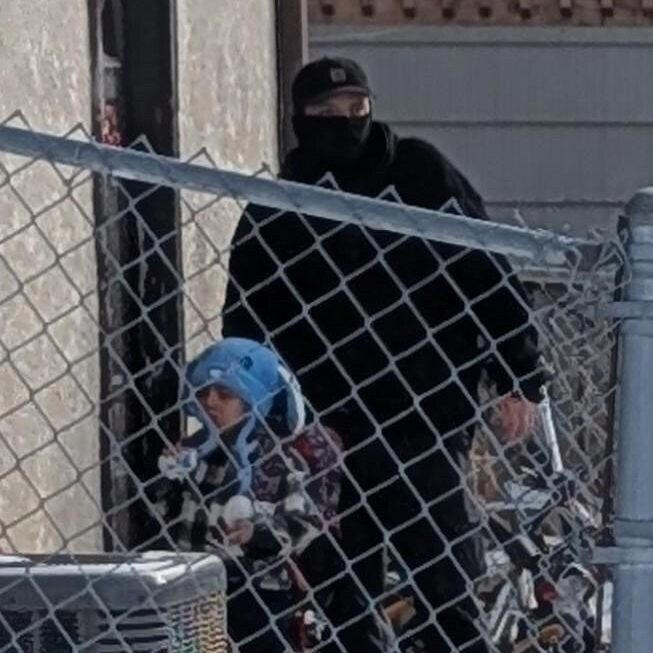
There is a photograph that should never have needed to exist.
A five-year-old boy stands in winter air, a bright blue hat pulled low, a Spider-Man backpack strapped to his shoulders. He looks exactly like what he is: a child coming home from preschool. Behind him stands an adult dressed in black, face covered, gloved hand gripping the child’s backpack—not to guide him, but to prevent him from running.
This is not a scene from a failed state or a distant authoritarian regime.
This happened in the United States.
The child, Liam Conejo Ramos, was detained during an immigration enforcement operation in Columbia Heights, a suburb of Minneapolis. He was not accused of anything. He was not a suspect. He was five years old.
That fact alone should have ended the story. Instead, it is where the story begins.
Power Without Proportion
Governments enforce laws. That is not controversial. Even harsh systems often justify themselves by claiming necessity, security, or order. But every functioning society relies on an unspoken principle that keeps those justifications from consuming everything else: proportionality.
Proportionality is the idea that power scales to its target.
That force recognizes context.
That authority knows when to stop.
When a masked, militarized adult detains a preschooler in his driveway, proportionality has collapsed.

What makes this moment so disturbing is not only the child’s fear, but the calmness of the procedure. According to local officials, another adult in the home begged agents to let him care for the boy. Instead, the child was reportedly led to his front door and told to knock—to see if anyone else was home.
A five-year-old was used as a tool in an enforcement action.
Not out of cruelty, necessarily. Not even out of malice. But because the system allowed it. Because no one in that moment said, this is where the rules end.
The Disappearance of Moral Friction
Large systems rarely become frightening all at once. They lose friction gradually.
Rules become routines.
Routines become reflexes.
Reflexes stop asking questions.

In 2018, images of children held in detention facilities shocked much of the country. The outrage came from visibility—the sudden confrontation with something people did not believe was happening. Years later, the shock has dulled. The infrastructure remains. The tactics adapt. The line quietly moves.
This time, the child was not behind a fence. He was in his own driveway.
And perhaps that is the point.
When enforcement reaches into the most ordinary spaces—homes, schools, neighborhoods—it no longer needs spectacle. It becomes ambient. Something people work around rather than confront.
In Columbia Heights, the response from the community reflected that shift. Coffee shops and small businesses began distributing food and medicine to families afraid to leave their homes. A sex-positive retail store became an impromptu aid center. Residents organized patrols to warn neighbors when immigration agents were nearby.
This is not chaos. It is disaster behavior.
When civilians start acting like first responders, it usually means trust in institutions has already eroded.

A City on Edge
The timing mattered. Just weeks earlier, a mother of three, Renee Good, was shot and killed during an encounter with immigration officers in the same metropolitan area. Video of the incident had already left the city tense and raw.
School officials reported multiple students detained in recent weeks. Parents feared sending children to class. Local businesses closed. Protests erupted. Federal deployments increased. National leaders threatened the use of extraordinary powers to restore order.

In moments like this, language shifts. Enforcement becomes “operations.” Neighborhoods become “targets.” People become numbers.
As of mid-January, federal data showed tens of thousands of individuals in immigration detention nationwide, many facing deportation proceedings. Numbers like these are often cited to demonstrate control. They rarely convey cost.
A statistic does not show you a child knocking on his own door because an adult told him to.
What This Moment Reveals
This is not an argument about borders. It is not a policy proposal. It is a question about limits.
Every society claims some lines should never be crossed. The treatment of children is usually one of them. When those lines blur, it signals something deeper than a single incident or agency.


It suggests a system that no longer feels the need to justify itself morally—only procedurally.
The most unsettling part of this story is not that a child was detained. It is that no extraordinary explanation was required. No emergency powers were invoked. No crisis was declared.
This was enforcement as usual.
History shows that when power becomes comfortable acting on the smallest and most vulnerable, it is rarely because those individuals are dangerous. It is because they are convenient. They cannot resist. They cannot object. They cannot complicate the process.
That should concern everyone, regardless of politics.
Let me be clear about where I stand.
I do not agree with this. I do not accept it as necessary, unavoidable, or defensible. Whatever one believes about immigration law, the use of state power against a five-year-old child is not enforcement — it is a failure of judgment and restraint. A society that cannot draw a firm line at children has already lost sight of the limits that keep power legitimate.
The Quiet Question Left Behind
There will be investigations. Statements. Legal arguments. Those are important, but they are not the heart of this moment.
The heart of it is simpler and harder to answer:
What does it say about a society when a child becomes an acceptable instrument of state power?
Not as an exception.
Not as a mistake.
But as part of the workflow.
That question does not end when the cameras turn away. It lingers—in school hallways, in shuttered storefronts, in neighborhoods where parents listen for unfamiliar engines before opening their doors.
And once a society learns to look past a frightened five-year-old in a Spider-Man backpack, it should not be surprised by what it learns to accept next.



Leave a Reply