
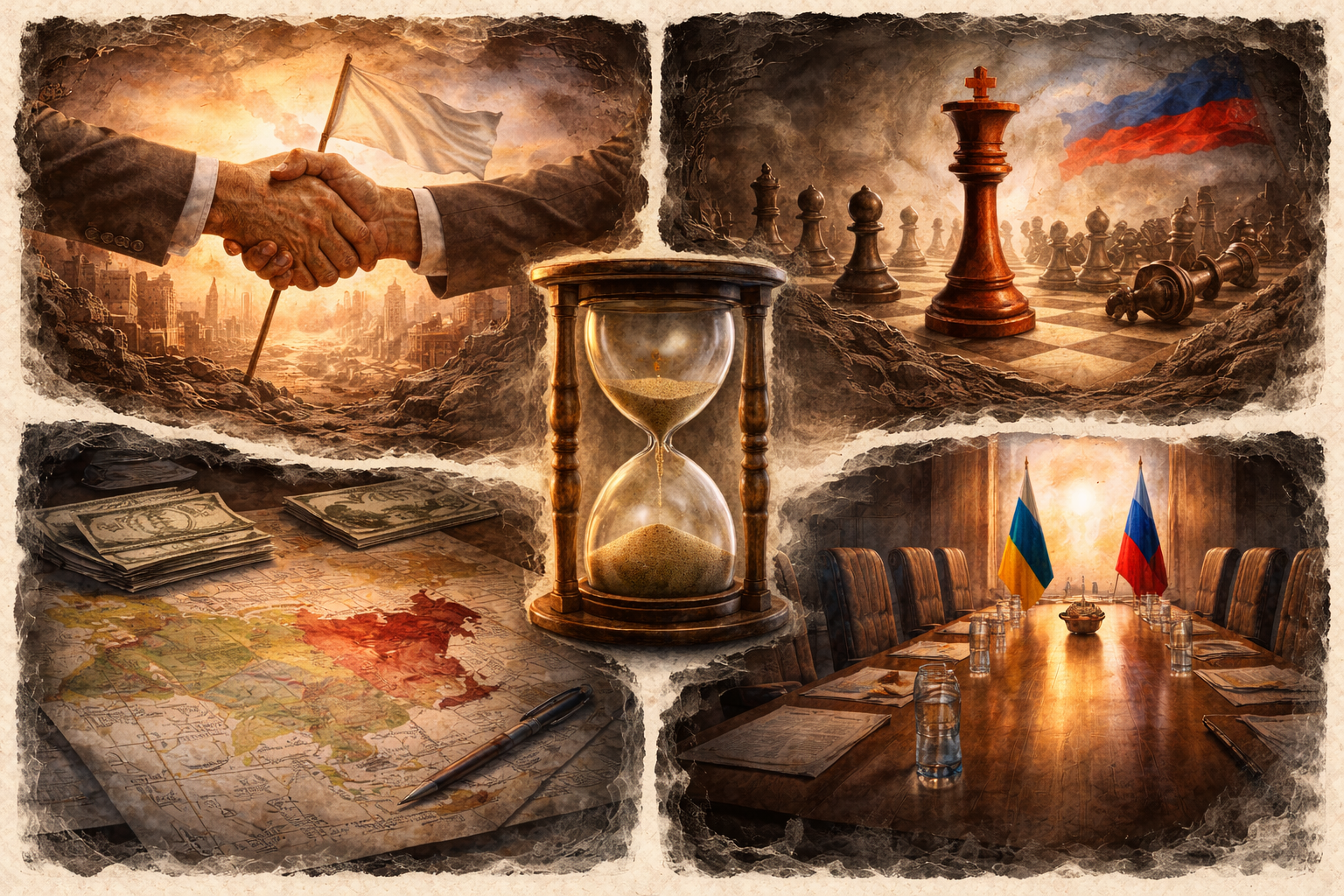
Why comforting assumptions keep colliding with reality. As the war drags on, a familiar set of ideas keeps resurfacing in public discussion.
They sound reasonable. They feel pragmatic. They often come wrapped in the language of realism and fatigue. And almost all of them rest on assumptions that don’t survive contact with how this war is actually being fought.
None of these myths come from malice. Most come from a deep human desire for resolution. But wanting something to end doesn’t change the conditions required for it to actually stop.
Here are five beliefs that continue to shape how people talk about ending the war, even as reality keeps disproving them.
Myth One: A ceasefire means peace
A ceasefire sounds like the obvious first step. Guns go quiet. Missiles stop flying. Civilians get a break.
But a ceasefire is not peace. It is a pause.
In wars of aggression, pauses overwhelmingly benefit the side that needs time to regroup. Forces rotate. Stockpiles are rebuilt. New units are trained. The underlying objective doesn’t change.
Russia has used ceasefires this way repeatedly. Silence becomes preparation.
Peace requires enforcement and deterrence. A ceasefire without those things is simply an intermission, not an ending.
Myth Two: Both sides want the same kind of ending
This myth quietly drives many calls for compromise.
It assumes that Ukraine and Russia are arguing over terms, not existence. That with enough pressure and creativity, both sides can find a mutually acceptable outcome.
But the goals are not symmetrical.
Ukraine’s objective is survival as a sovereign state. Russia’s objective, articulated openly and repeatedly, is control. Not influence. Not security guarantees. Control.
That asymmetry matters. Negotiations only work when both sides are seeking an outcome that allows the other to continue existing as they are.
This war does not meet that condition.
Myth Three: Time makes compromise easier
There is a widespread belief that wars naturally soften positions over time. That exhaustion leads to flexibility.
Sometimes that’s true.
But in wars driven by ideology and imperial ambition, time often hardens positions instead. Sunk costs grow. Narratives calcify. Concessions become politically impossible.
For Ukraine, time means more graves, more destruction, and more evidence of what occupation actually looks like. For Russia, time means further militarization and normalization of aggression.
Fatigue doesn’t automatically create peace. Sometimes it just lowers resistance to bad deals.
Myth Four: Territory can be traded for stability
This is one of the most persistent and dangerous ideas.
The logic sounds simple: give up land, end the fighting, stabilize the region.
The problem is that territory is not just land. It’s people, resources, strategic depth, and precedent.
Rewarding territorial conquest teaches a lesson far beyond Ukraine. It signals that borders are conditional, and force is negotiable. That lesson doesn’t stay contained. It spreads.
Ukraine understands this instinctively. Giving up territory doesn’t buy stability. It buys a delayed repeat, under worse conditions.
Myth Five: This war ends at the negotiating table
Negotiations are often described as the inevitable conclusion of all wars.
That’s only half true.
Wars end at the negotiating table after one side accepts that continuing the fight is worse than stopping. That acceptance doesn’t come from dialogue alone. It comes from deterrence, cost, and constraint.
In this war, negotiations are not the engine of resolution. They are the paperwork that follows a change in incentives.
Until aggression becomes unsustainable, talks are process without outcome.
Why these myths persist
These ideas survive because they offer emotional relief.
They allow distant audiences to imagine an ending that doesn’t require long-term commitment, uncomfortable choices, or sustained attention. They transform a grinding conflict into a solvable puzzle.
But wars are not puzzles. They are contests of will, capacity, and consequence.
Clinging to myths doesn’t make the war end faster. It just delays the moment when reality is faced directly.
The uncomfortable truth
Ending this war will not feel neat.
It will not arrive as a single announcement or a satisfying headline. It will come through sustained pressure, deterrence that holds, and choices that remain politically difficult long after public attention wanes.
Negotiations may play a role. They always do.
But believing in myths about how wars end makes peace harder, not easier.
Ukraine doesn’t need better stories about endings. It needs conditions that prevent repetition.
And those conditions begin with letting go of the myths that make us feel better while leaving the problem unresolved.



Leave a Reply