
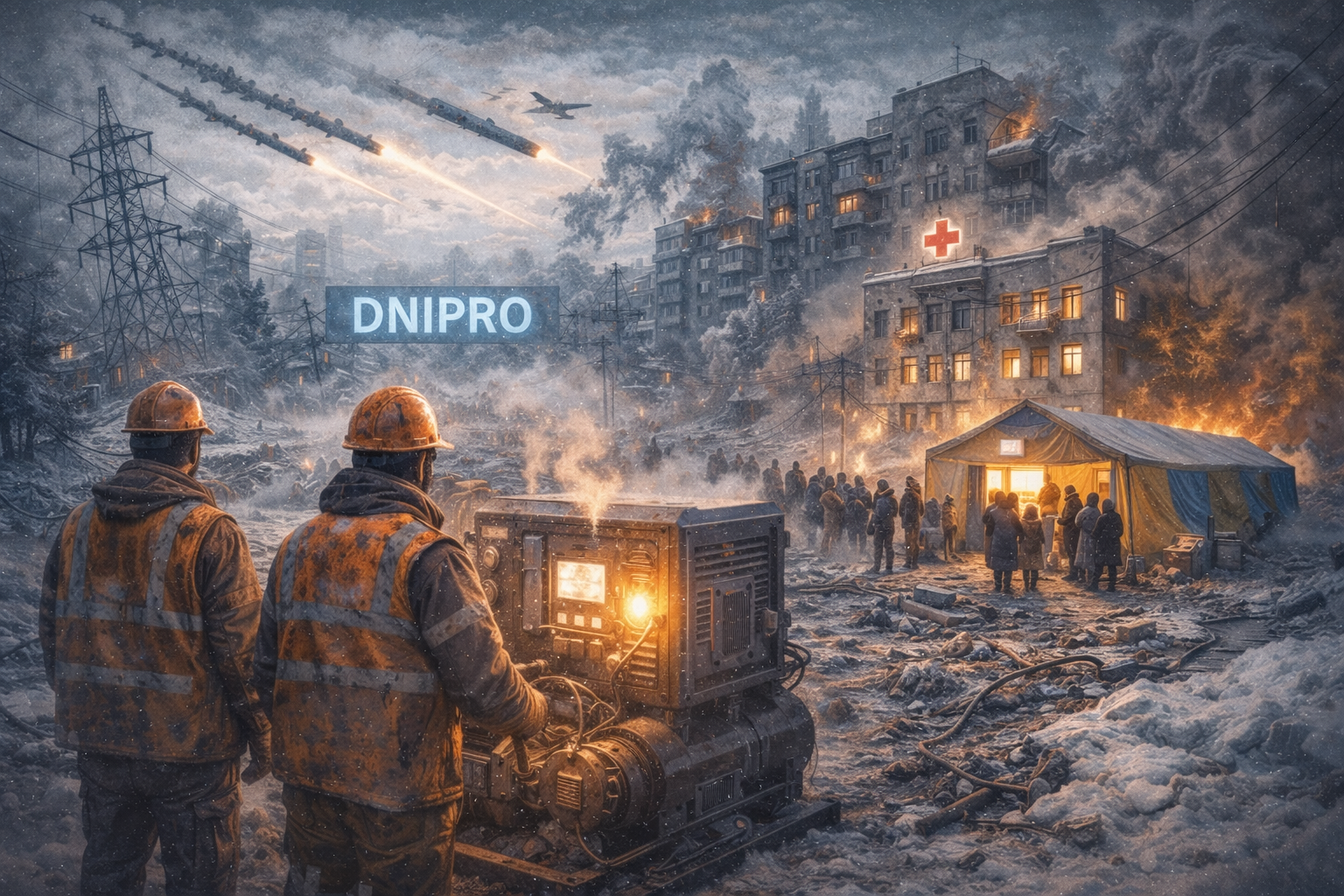
When Dnipro’s mayor says the city is facing a national-level emergency, that’s not political drama or rhetorical inflation. It’s an administrative signal. In Ukrainian governance language, it means systems are failing faster than they can be stabilized, and local fixes aren’t enough anymore.
What happened on the night of January 7–8 wasn’t just another strike in a long war. It was a systems-level hit that exposed how fragile modern cities become when electricity disappears in winter.
And winter, in eastern Ukraine, doesn’t negotiate.

Why This Attack Was Different
Russian strikes on energy infrastructure aren’t new. Ukraine has been dealing with them for years now. But this attack landed at a particularly dangerous intersection of factors:
- Deep winter temperatures
- Sustained grid pressure from previous attacks
- High urban population density
- Heating systems fully dependent on electricity
Dnipro sits at the center of Ukraine’s industrial and logistical spine. It’s not a frontline city, but it’s a support city for the front. That makes it strategically valuable and structurally complex.
When the power went out, it didn’t just mean darkness. It meant boiler houses went dead.
And once boilers go offline in winter, the clock starts ticking.
Electricity Is Recoverable. Heat Is Not
Here’s the first thing people outside Ukraine often miss:
Restoring electricity and restoring heat are not the same problem.
Electricity can be rerouted. Lines can be switched. Generators can bridge gaps.
Heating systems can’t.
Dnipro’s district heating relies on electrically powered boiler houses. When the blackout hit, every single one lost power. No circulation. No pressure. No heat.
Restarting them isn’t as simple as flipping a switch. Pipes cool. Water contracts. Microfractures form. Pumps seize. Restarting too quickly can rupture the system and make things worse.
That’s why city officials were blunt: heat is the hardest problem.
You can live in the dark for a while.
You can’t live in a frozen apartment building.
How the City Is Holding the Line
To their credit, municipal services moved immediately.
Hospitals were switched to backup power. Water and sewage systems were stabilized faster than expected. The right-bank water supply came back online. The left bank stayed alive on alternative sources.
Schools were closed not because of “safety concerns,” but because classrooms without heat become uninhabitable within hours.
Healthcare facilities are operating on generators, with fuel reserves monitored constantly. This isn’t ideal, but it’s functional.
The city also activated Points of Resilience: warming centers meant to give people heat, power, and communication access. These aren’t symbolic gestures. They’re lifelines when residential buildings drop below survivable temperatures.
But even those points depend on logistics. Fuel. Staffing. Security. Maintenance.
Emergency management is now running on endurance, not margin.
Zoom Out: This Is a Pattern, Not an Isolated Crisis
Dnipro is not alone.
Across the country, Russian strikes hit energy infrastructure in waves. Zaporizhzhia remains under sustained grid stress. Kryvyi Rih was hit with an unprecedented multi-vector attack, striking multiple locations at once.
This is what escalation looks like when territorial advances slow.
If you can’t take ground quickly, you degrade systems.
If you can’t break the army, you strain the cities that support it.
The goal isn’t immediate collapse. It’s exhaustion.
Why Winter Changes the Equation
War in winter amplifies everything.
A missile that damages a transformer in July is an inconvenience.
The same strike in January becomes existential.
Cold turns infrastructure damage into human risk very fast. Pipes burst. Elevators fail. Hospitals strain. Water freezes. Buildings become unsafe.
And unlike summer outages, people can’t simply “wait it out.”
This is why heating remains the single most sensitive vulnerability in Ukrainian cities right now.
Electricity outages hurt.
Heating outages kill.
What “National Emergency” Really Means
When Mayor Borys Filatov called this a national-level emergency, he wasn’t asking for sympathy. He was signaling escalation in response.
A national emergency designation does three things:
- Unlocks central government resources
- Allows faster inter-agency coordination
- Moves responsibility beyond city limits
Dnipro is no longer handling this alone. Ministries are involved. Regional military administration is fully integrated. Energy specialists are being redeployed.
That’s not panic. That’s procedure.
The Strategic Message Behind the Strikes
From a military perspective, this attack wasn’t about optics. It wasn’t about headlines. It was about pressure.
Pressure on:
- Urban resilience
- Civilian morale
- Emergency response capacity
- Government bandwidth
Every hour spent restarting boilers is an hour not spent elsewhere. Every generator running is fuel diverted. Every repair crew deployed is manpower exposed.
This is attritional warfare applied to cities.
What Comes Next for Dnipro
The immediate priorities are clear:
- Restore boiler house power safely
- Prevent pipe ruptures during restart
- Maintain hospital generator operations
- Keep water and sewage stable
- Expand warming access if needed
The longer-term concern is repetition.
Dnipro can survive one emergency.
Multiple, back-to-back events are where systems start to fail structurally.
That’s why officials are urging residents to rely on official channels only. Misinformation during infrastructure crises spreads faster than cold.
Why This Matters Beyond One City
Dnipro is a case study.
It shows how modern warfare targets systems, not just territory. It highlights why energy defense matters as much as air defense. And it underlines why winter remains one of Ukraine’s most dangerous adversaries.
Cities don’t collapse all at once.
They fray.
And right now, Ukraine’s cities are holding—but only because of constant, exhausting effort.
The Bottom Line
Dnipro isn’t frozen. It isn’t dark. It isn’t abandoned.
But it is operating without margin.
This wasn’t just another strike. It was a reminder that in this war, infrastructure is the battlefield, winter is the amplifier, and resilience is something that has to be rebuilt every single day.
The city is standing.
The question is how many more nights like this it can absorb—and how quickly the systems meant to protect civilians can be reinforced before the next wave hits.




Leave a Reply