
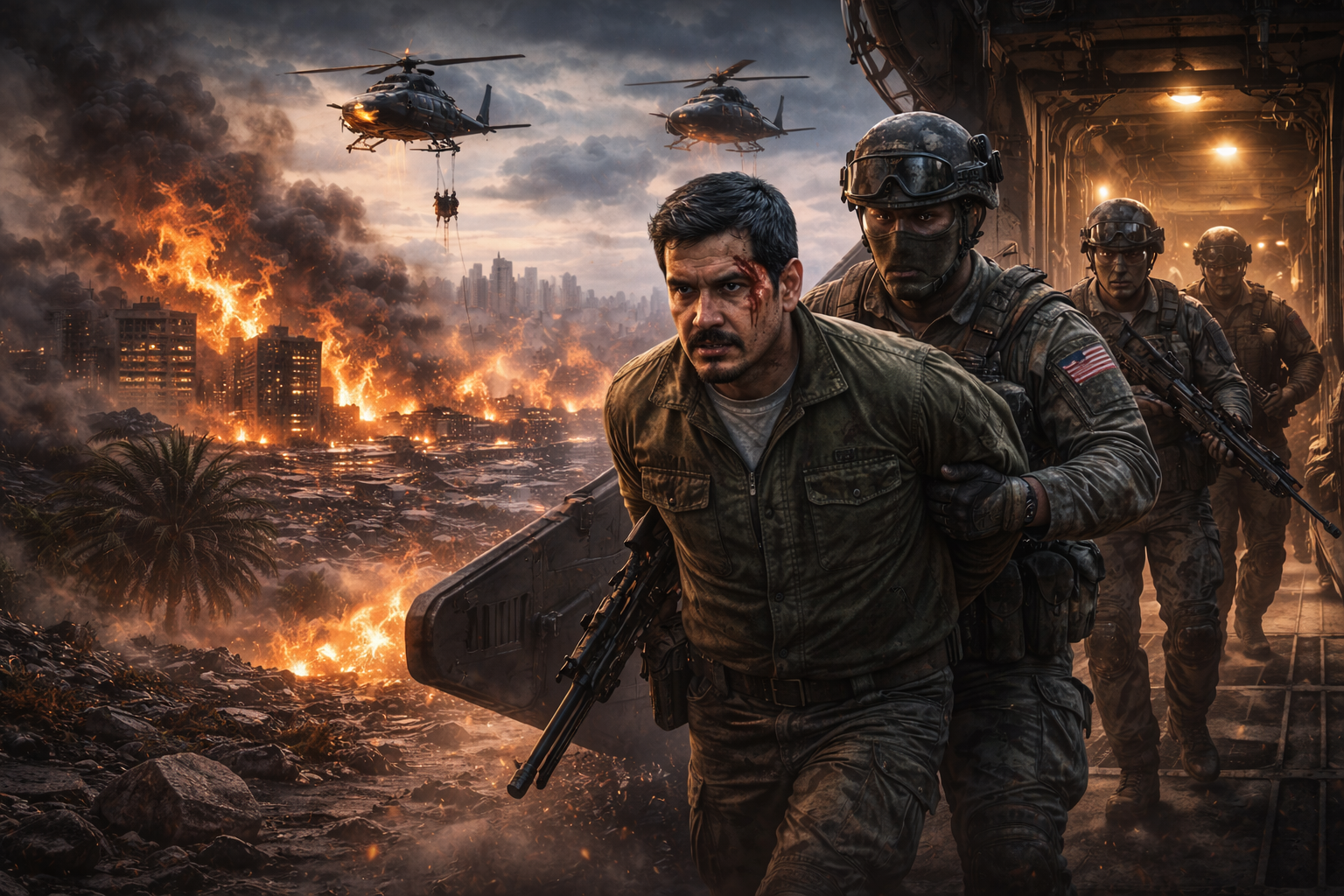
If you had written this as fiction a year ago, most editors would have bounced it back as unrealistic. But early on January 3, the United States carried out a direct military operation inside Venezuela, striking key targets in Caracas and removing President Nicolás Maduro from the country.
The operation happened fast and, at least so far, appears deliberately limited.
Around 2 a.m. local time, aircraft were reported over Caracas, followed by explosions near major military installations. Targets reportedly included Fort Tiuna, a core military base, the Generalissimo Francisco de Miranda Air Base, the National Assembly building, and the residence of Defense Minister Vladimir Padrino López.
Residents also reported helicopters moving low over the city. The aircraft types identified, including CH-47 Chinooks and MH-60 Black Hawks, are typically associated with U.S. special operations aviation, the kind used for rapid insertion and extraction missions rather than prolonged fighting.
A few hours later, Donald Trump confirmed what many were already piecing together: this was not a full invasion, but a targeted strike aimed directly at Venezuela’s leadership. Maduro, Trump said, had been captured and flown out of the country.
That single sentence instantly raised the bigger question. Is this the start of a wider war, or something far more contained?
Venezuela’s Immediate Reaction
Inside Venezuela, there’s no clear sign yet that power has fully shifted.
In the hours before Trump’s announcement, Venezuela’s foreign minister said Maduro had declared a nationwide state of emergency and ordered full mobilization of the armed forces and political structures. That statement now reads less like a reaction and more like a system bracing for impact.
Defense Minister Padrino López quickly pledged resistance, insisting the government would not surrender. But with Maduro gone, the real issue isn’t rhetoric. It’s whether the system he built can function without him at the center.
That system is complicated. Over the years, Maduro’s government prepared for exactly this kind of scenario by tightening internal security, empowering paramilitary groups, and cultivating support from external partners like Russia, China, and Iran.
Public opinion adds another layer of uncertainty. Polling inside Venezuela suggests a significant portion of the population still views Maduro’s leadership favorably, while Venezuelans who fled the country overwhelmingly support outside intervention. That split matters if the U.S. hopes for anything resembling a smooth transition.
Why the U.S. Did This
Trump has been signaling some version of this move for months.
Publicly, the justification has focused on drug trafficking and what the administration calls “narco-terrorism.” Less publicly, Washington has been pressing Caracas over nationalized American assets and frozen investments. Neither issue is realistically resolved without a change in leadership.
The U.S. also maintains close ties with Venezuelan opposition leader María Corina Machado. But here’s the problem: she cannot simply walk into Caracas and assume power. Without security guarantees, she would almost certainly be detained or killed. Supporting her return would require an expanded U.S. presence.
That’s where history starts whispering warnings.
In 1989, the U.S. removed Panama’s leader Manuel Noriega in an operation that initially looked clean and decisive. It didn’t stay that way. Venezuela is far larger, more politically entrenched, and backed by stronger external allies.
Two Very Different Paths Forward
Right now, there are two plausible scenarios.
The first is escalation. The U.S. gets pulled deeper into stabilizing Venezuela, protecting opposition figures, and managing internal resistance. That path looks less like a raid and more like a prolonged intervention.
The second is more in line with Trump’s political instincts. Maduro is tried publicly, a deal is cut quietly with whoever emerges next, and the U.S. steps back while claiming a decisive win. Some opposition figures believe this operation was already a negotiated exit rather than a chaotic takedown.
Which path Washington chooses will shape everything that follows.
Why This Matters Outside Venezuela
For most of the world, the immediate question isn’t Caracas. It’s oil.
Markets haven’t reacted yet, largely because the operation happened over a weekend. But if Venezuelan oil production stabilizes and begins flowing freely again, it could put downward pressure on global prices.
That would be particularly bad news for Russia, which remains heavily dependent on energy exports to fund its war and economy. Even a modest increase in global supply can have outsized political consequences.
A Shock That Hasn’t Settled Yet
For now, the dust hasn’t settled. Maduro is gone, but the structure he left behind remains. The U.S. has made a dramatic move, but hasn’t yet revealed how far it’s willing to go to shape the outcome.
This may end up being remembered as a bold, surgical operation that reshaped Venezuela’s future without igniting a wider conflict.
Or it may be the opening chapter of a mess that no one fully controls.
Either way, it’s a reminder that in geopolitics, the most unbelievable headlines are often the ones that deserve the closest look.



Leave a Reply