
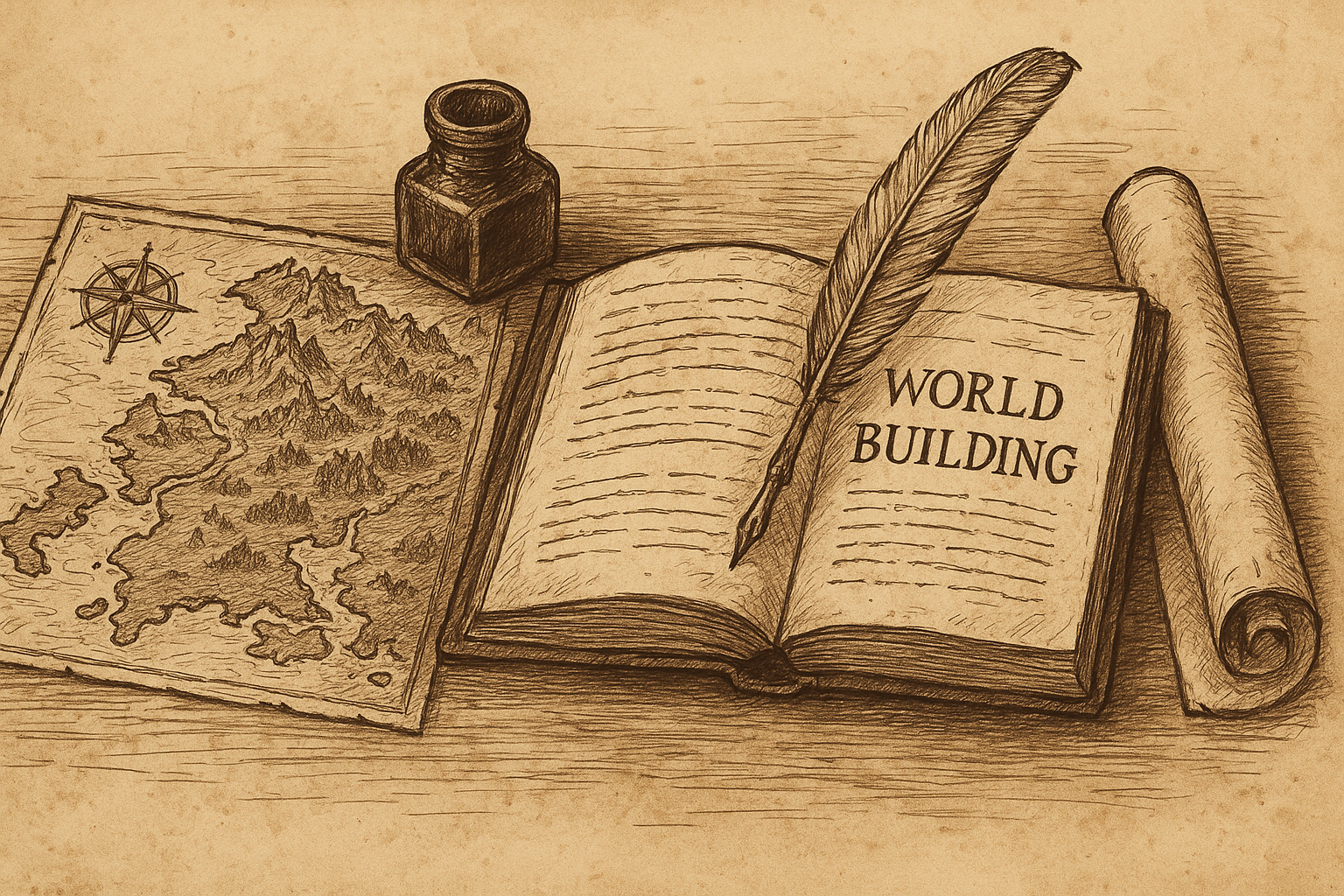
INTRODUCTION — WHY WORLDBUILDING ACTUALLY MATTERS
Pull up a chair and slide that mug closer. Let’s be honest about something right from the top: worldbuilding is one of the most overcomplicated, over-explained, and over-glorified parts of writing fantasy. Everyone’s got a method, a checklist, a 400-page bible of lore they never use, three abandoned maps, and a deep sense of guilt that their world isn’t “complex enough.”
Forget all that.
Worldbuilding isn’t about creating a museum exhibit. It’s not about stuffing your story with decorative facts or naming every mountain peak like you’re filling out tax forms for the gods.
Worldbuilding is about meaning.
It’s about building a place readers feel. A world that breathes, sweats, roars, whispers. A world that shapes your characters and pushes them forward. A world that feels so natural readers forget it’s fictional.
And if you do it right, your world becomes a place readers come home to.
That’s what we’re building here: not just fictional terrain, but emotional truth, living cultures, and the quiet little details that make a world believable.
So let’s break this down, step by step, without the shame, stress, or perfectionism. This is the definitive guide — your guide — written in plain English, with practical examples, and a whole lot of clarity.
Let’s get into it.

SECTION I — THE HEARTBEAT BENEATH EVERYTHING (IDENTITY)
Every world has a soul.
You can’t see it on a map. You can’t summarize it in a paragraph. But it’s there — the thing your world “believes” about itself.
Identity is the emotional, thematic spine of your setting.
It’s the heartbeat that keeps everything else consistent.
Before you build anything — a mountain range, a kingdom, a magic system — ask one question:
“What does this world feel like at its core?”
Not genre. Not plot. Not aesthetics.
Identity.
Here are a few examples:
- A world where the gods once walked the earth but abandoned it
- A world where history has been erased, deliberately
- A world where magic is dying
- A world built on oaths and consequences (hello, Forged in Oath)
- A world shaped by ancient wars in the stars (Chronicles of the Void)
All those identities shape everything else.
In Forged in Oath, the world’s identity revolves around binding vows and the price of breaking them. That single truth flows outward to the magic, the cultures, the wars, the religions — even the landscapes. The world “feels” heavy with promises, broken and kept.
Identity isn’t a description.
It’s a direction.
Once you choose your world’s identity, every detail becomes easier. If a choice aligns with the soul of the world, it stays. If it clashes, it goes.
Identity saves you from chaos.
It’s your compass.

SECTION II — THE BONES OF YOUR WORLD (GEOGRAPHY, CLIMATE, LOGIC)
Now let’s talk land.
Not random shapes on a map. Not a doodle of mountains dropped wherever they look cool. (No shame — we’ve all done the “mountain sneeze.”)
I’m talking about logical, meaningful, story-shaping geography.
Geography shapes culture.
Mountains create isolation.
Deserts breed toughness and unity.
Coastlines encourage trade, naval warfare, and cultural mixing.
Forests become sources of fear, myth, or resources.
Rivers create borders and cities.
Plains raise horse empires.
Islands birth seafarers.
Your world’s terrain is not decoration. It’s infrastructure, personality, conflict, and history.
In Chronicles of the Void, the broken, fractured continents influenced the entire political landscape — travel restrictions, scarce resources, and contested territory for star-born energy all shaped society’s paranoia and militarization. Geography created story.
Climate matters more than fantasy writers admit.
Climate dictates:
- Clothing
- Food
- Shelter
- Construction
- Farming
- Warfare
- Festivals
- Migration patterns
- Religious beliefs
- Disease
- Trade routes
- Survival strategies
Don’t worry about being a meteorologist.
Just ask basic grounding questions:
- What do people wear here?
- What kills them in winter?
- What crops grow?
- What animals thrive?
- How long is summer?
- How dangerous is travel?
Don’t forget the “world logic” test.
Every fantasy world obeys reality in some capacity. Even magical ones.
Things to keep consistent:
- Gravity
- Seasons
- Time
- Resources
- Population limits
- Distance
- Travel speed
- Food supply
- Water sources
If a kingdom has one tiny river and twenty million people… no.
If a city exists in a desert and has no magic or trade keeping it alive… also no.
Readers won’t know why something feels wrong — but they’ll feel it.
The bones of your world must hold weight.

SECTION III — THE PULSE OF DAILY LIFE (CULTURE & CIVILIZATION)
Here’s where worldbuilding becomes irresistible.
Cultures are the heartbeat of a believable world, because they mirror who we are: flawed, proud, desperate, joyful, terrified, ambitious, divided, united, human.
Start with this simple rule:
Culture = People reacting to their environment.
If they live on cliffs, they build vertical architecture.
If they’re nomads, they carry portable homes.
If winters kill half the population, their folklore is full of ghosts.
If they live beneath a volcano, they believe the gods must be appeased.
Culture isn’t random decoration.
It’s the long-term emotional reaction of a people to the land and dangers around them.
Build culture using lived-in details.
Ask:
- What do they eat everyday?
- What insults are considered unforgivable?
- What are children taught?
- What holidays matter most?
- What stories do grandparents tell?
- What superstition keeps people awake at night?
- What colors are reserved for royalty?
- Who buries the dead — and how?
These details turn cardboard cultures into real civilizations.
Example:
In Shadow War: Rise of Galliard, the people’s fear of shadows isn’t just aesthetic — it grows from centuries of documented attacks by shadowspawn. Rituals, weapons, festivals, and even children’s games evolved around that danger. Culture emerged from threat.
Dialect & naming
This is the part writers love to overdo — and readers skim. Keep it simple:
- A single vowel rule
- Repeated syllable patterns
- Honorifics
- Short forms
- Naming traditions
Done.
Why cultures need contradictions
No culture is one note.
A civilization can be deeply honorable but deeply brutal.
Peace-loving but politically ruthless.
Pious but corrupt.
Hospitable but suspicious of strangers.
If your culture has no contradictions, it isn’t human.

SECTION IV — POWER, COST, AND CONSEQUENCE (MAGIC & MYTH)
Now we get to the good stuff: magic.
Magic is the engine that powers half of fantasy. But it’s also the easiest thing to mess up.
Magic without cost is a cheat code.
This is the big one. Let me be blunt:
If magic can solve every problem, nothing matters.
Magic must have:
- A cost
- A limitation
- A consequence
- A danger
- A moral dimension
Otherwise your story becomes a parade of convenient solutions.
Decide what kind of magic your world uses:
Hard magic
Rules are clear (like Sanderson). Great for problem-solving plots.
Soft magic
Mysterious and mythic (Tolkien). Great for atmosphere and awe.
Hybrid
Clear rules + mysterious depths. Most modern fantasy does this.
Magic should affect society.
If magic exists, it should touch:
- Religion
- Medicine
- Warfare
- Crime
- Politics
- Architecture
- Travel
- Education
- Economy
If magic doesn’t change society, why does it exist?
Myth & gods
Myth is the emotional memory of a world. Use myth to:
- Explain natural disasters
- Justify wars
- Shape holidays
- Create morality systems
- Build origin stories
Example:
In Forged in Oath, magic’s cost is tied directly to faith, bloodline, and ancient vows. That cost shaped nations, political orders, and the entire religious landscape.
Good magic systems make the world deeper — not easier.

SECTION V — WHO WANTS WHAT, AND WHY? (POLITICS & POWER)
Let’s talk about the fun, messy part: power.
Every believable world needs competing interests. Conflict doesn’t come from dragons or magic artifacts — it comes from people.
Start with one simple truth:
Politics is just people trying to get what they want.
What do factions want?
- Land
- Resources
- Trade dominance
- Religious authority
- Security
- Revenge
- Prestige
- Survival
- Independence
- Control of magic
Once you know what each group wants, the world writes its own conflicts.
Political structures
Kings, councils, clans, guilds, matriarchies, republics, theocracies — you don’t need complexity for its own sake. You need clarity.
Build political systems that make sense for the geography and culture.
Warfare & logistics
If your world has wars, remember:
- Armies need food
- Armies need water
- Armies need roads
- Armies need rest
- Armies need political justification
- Armies create refugees
- Armies reshape borders
War is not aesthetic. War is consequence.
Example:
In Forged in Oath, power struggles between ancient families, knightly orders, and the remnants of divine authority create tension at every level. The world feels alive because everyone wants something incompatible with someone else.

SECTION VI — THE GHOSTS BENEATH THE SURFACE (HISTORY & LORE)
History gives your world weight.
Readers don’t need to know every date or dynasty. They just need to feel the echoes.
History should haunt the present.
- Old grudges
- Ancient ruins
- Forgotten wars
- Collapsed empires
- Abandoned faiths
- Cursed bloodlines
- Lost heroes
- Forbidden magic
These things shape decisions long after the events themselves.
Don’t write a textbook.
History should be:
- Rumored
- Conflicted
- Disputed
- Fragmented
- Biased
- Weaponized
People argue about history — even in fantasy worlds.
Example:
In Chronicles of the Void, the long-dead civilizations whose ruins still pepper the landscape create tension, ambition, and fear. Everyone wants to know what the ancients left behind — and why they fell.

SECTION VII — THE THINGS READERS NOTICE (LIVED-IN DETAILS)
This is the secret sauce.
The little details are what make a world feel lived in.
Ask yourself:
- What does a marketplace smell like?
- What sound does a holy bell make at dawn?
- What curse do people shout when startled?
- How do soldiers greet each other?
- What meal is eaten when someone dies?
- What are children warned never to touch?
Small details anchor the big ideas.
Show, don’t dump
Instead of explaining your culture, let your characters experience it.
Instead of describing a religious belief, show a ritual.
Instead of explaining your magic system, show the cost.
Example:
A soldier in Forged in Oath grips the talisman of a broken vow before battle — a tiny moment that implies an entire cultural belief system behind it.
These details make worlds unforgettable.

SECTION VIII — THE QUICKSAND PIT (COMMON MISTAKES)
Let’s call these out, friend to friend.
1. The Overbuilt World Bible
If you wrote 200 pages of lore and use 2 of them… you built a museum, not a story.
2. The Empty Map Syndrome
A pretty map with no meaning behind it.
3. Magic That Solves Everything
Magic should make problems bigger, not smaller.
4. Cultures With No Flaws
If a culture has no contradictions, it’s propaganda.
5. Cities That Shouldn’t Exist
If a city has no trade, water, food, or purpose… delete it.
6. History Written Like a Wikipedia Page
Lore is memory, not a documentary.
7. Languages That Don’t Fit the Culture
Names should match geography, history, and phonetic style.
8. Nothing Makes Life Hard
If your world has no friction, it’s not alive.
A good world makes your characters miserable — and gives them strength through it.

SECTION IX — THE WORLDBUILDING CHECKLIST
Before you close this tab, your world should have:
- A clear identity
- Logical geography
- Meaningful climate
- Cultures shaped by environment
- Consistent magic with cost
- Political conflict with purpose
- History that haunts the present
- Lived-in detail
- Internal logic
- A sense of emotional truth
If you’ve got those, trust me — your world is already stronger than most.
FINAL TAKEAWAY — WHY WE BUILD WORLDS AT ALL
Fantasy worlds aren’t just places to set stories.
They’re mirrors.
When we build worlds, we explore our fears, our hopes, our flaws, our wishes. We translate parts of ourselves into myth — then let our characters wander through them in search of meaning.
A believable fantasy world isn’t about realism.
It’s about truth.
And the truth is simple:
People don’t fall in love with worlds that are perfect.
They fall in love with worlds that feel alive.
If your world breathes, your story will, too.
Now take this guide, grab that notebook, sketch the first idea that sparks, and begin.
Your world is waiting.


Leave a Reply