
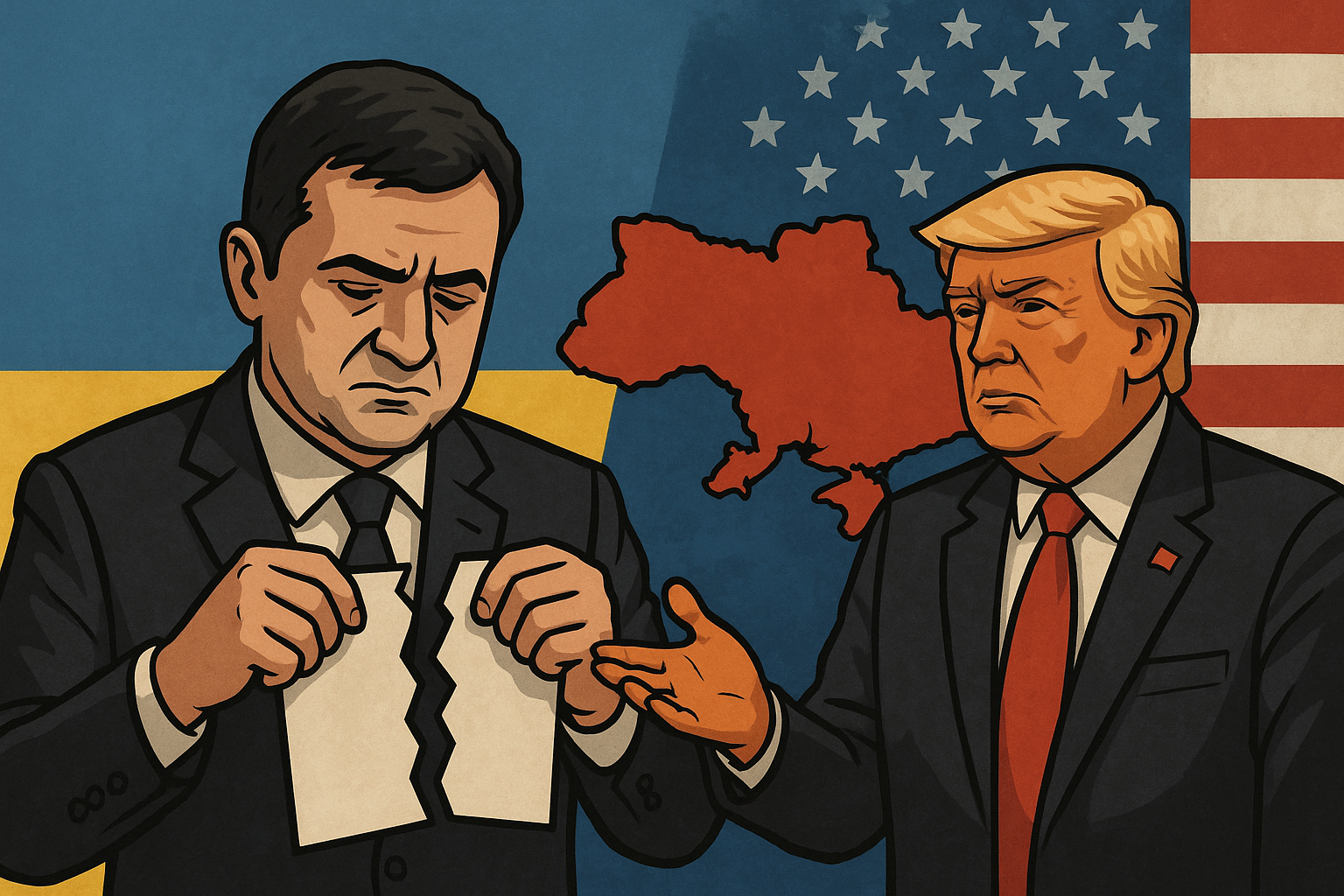
Ukraine’s leadership is undergoing a shake-up at a critical moment. On November 28, President Volodymyr Zelenskyy announced the resignation of his Chief of Staff, Andriy Yermak, amid a high-profile corruption investigation. The move comes just as intense peace negotiations – driven by the United States – propose to recognize Russian control over large swathes of occupied Ukrainian territory in exchange for a ceasefire. These dual developments underscore the mounting pressure on Kyiv, both internally and externally, as it fights Russia’s invasion while also battling graft within and navigating fraught diplomatic proposals.
Yermak’s Resignation and the Operation “Midas” Scandal
In his nightly address on Nov. 28, Zelenskyy revealed that Andriy Yermak, head of the President’s Office, had submitted his resignation, and that Zelenskyy accepted it as part of a “reboot” of his office. Zelenskyy praised Yermak for his service, noting he had always represented Ukraine patriotically in negotiations. However, the president stressed that with the war raging, Ukraine’s government cannot afford any distractions or doubts – either for Ukrainians or for international partners. This was a clear reference to the corruption storm surrounding Yermak.

Earlier that same day, anti-corruption investigators raided Yermak’s home in Kyiv, in a dramatic escalation of a probe codenamed “Operation Midas.” The National Anti-Corruption Bureau (NABU) and Specialized Anti-Corruption Prosecutor’s Office (SAP) carried out court-sanctioned searches at Yermak’s residence on the morning of Nov. 28. Yermak confirmed the search on social media, saying investigators were given full access and that he was cooperating through his lawyers.
Operation Midas is a far-reaching investigation into alleged graft in Ukraine’s energy sector, specifically kickback schemes involving the state nuclear company Energoatom. According to NABU, a group of insiders was siphoning off 10–15% “commission” from Energoatom contracts, and funnelling the money through shadowy channels – a scheme reportedly orchestrated by businessman Timur Mindich, a co-owner of Zelenskyy’s former entertainment company and a close associate of the president. Mindich was tipped off and fled the country just before his home was searched. Investigators have also targeted or charged several high-level figures: former Energy Minister Herman Halushchenko and his successor Svitlana Hrynchuk were both dismissed, and ex-Vice PM Oleksiy Chernyshov (allegedly heard on tapes under codename “Che Guevara”) has been formally charged. Even Rustem Umerov, the Secretary of the National Security and Defense Council (and former Defense Minister), was questioned over possible links to Mindich. Over $100 million may have been laundered in this scheme, making it the biggest corruption scandal of Zelenskyy’s presidency.

Crucially, Yermak’s name surfaced in the investigation via secret audio recordings often referred to as the “Mindich tapes.” Unconfirmed leaks suggest a figure nicknamed “Ali Baba” can be heard instructing officials to undermine Ukraine’s anti-corruption agencies (SAP and NABU) – and many suspect this was Yermak. NABU’s director neither confirmed nor denied Yermak’s involvement, but the mere possibility created a political firestorm. Some of Zelenskyy’s own parliamentary allies had begun openly discussing Yermak’s ouster to restore public trust. Anti-corruption activists argued that Zelenskyy needed to remove tainted insiders like Yermak to prove he wasn’t complicit. As Daria Kaleniuk of Ukraine’s Anti-Corruption Action Center put it, “For the president to prove he’s not part of the scheme… he needs to get rid of all these corrupt inner circle friends – including Mr. Yermak”.
Yermak has not been formally accused of a crime at this time, and he maintains his innocence. Yet the political optics of the situation were untenable. Ukraine’s Western partners, who are funding and arming its defense, have made clear that credible anti-corruption efforts are essential for continued support and EU candidacy. The European Commission swiftly reacted to the Yermak raid, noting it showed Ukraine’s anti-graft bodies acting within their mandate and reiterating that fighting corruption “is key” to Ukraine’s EU ambitions. Poland’s defense minister likewise said support for Ukraine remains firm but emphasized the need for transparency, “awaiting clarification” on the case. In this climate, Zelenskyy’s acceptance of Yermak’s resignation was widely seen as a move to shore up confidence: both domestically (signaling no one is above accountability) and externally (removing a potential stain in the eyes of partners).

Andriy Yermak, Former Head of the Office of the President of Ukraine | Credit: Vitalii Nosach, RBC-Ukraine
Zelenskyy Reshuffles His War Team
Zelenskyy framed Yermak’s departure as part of a broader “reboot” of the presidential office to keep the focus on Ukraine’s defense. After more than five years as his top aide – the longest anyone has held that powerful post – Yermak’s exit marks a significant change in Zelenskyy’s inner circle. It comes on the heels of other wartime shake-ups; for example, Zelenskyy replaced his defense minister in early autumn and his security council chief earlier in November. The president is effectively retooling his team amid the war’s most delicate phase, where both military and diplomatic fronts are active.

In announcing the resignation, Zelenskyy was careful to quell rumors. “I want there to be no rumors or speculation,” he said, adding that consultations would be held on a new Head of the Office and that he would name a successor soon. Potential candidates are the subject of much chatter in Kyiv, but no appointment had been made as of the announcement.
In the interim, Zelenskyy also revealed an important detail: Ukraine’s representation in ongoing negotiations will change. He stated that in upcoming talks with international partners, Ukraine will be represented by:
- General Andrii Hnatov, Chief of the General Staff of the Armed Forces
- Officials from the Ministry of Foreign Affairs (likely Foreign Minister Dmytro Kuleba or his deputies)
- Rustem Umerov, the Secretary of the National Security and Defense Council (despite Umerov’s name appearing in the energy probe, Zelenskyy seems to trust him in this key role)
- Intelligence representatives
This lineup pointedly excludes Yermak, who until now had often been Ukraine’s lead negotiator or interlocutor in talks with Russia and the West. Yermak was a fixture in back-channel dialogues (from prisoner swaps to peace feelers) and chaired Kyiv’s delegation in negotiations like the Normandy Format and talks with the U.S. about security guarantees. His removal could signal a shift to a more institutional and less one-man-driven approach in negotiations. It may also reassure some in Washington and Brussels who privately harbored reservations about Yermak’s outsized role and opaque style. (Reportedly, some Western officials were frustrated with Yermak’s “gatekeeping” tendencies and preferred dealing with other Ukrainian officials.)
By clearing out a controversial figure at home, Zelenskyy hopes to maintain unity and credibility as Ukraine faces a pivotal juncture. The war is nearing the four-year mark, Ukrainian forces are slogging through tough battles in Donetsk and Zaporizhzhia, and diplomatic pressure is mounting to at least pause the fighting. It’s against this backdrop that the U.S. peace plan emerged – a plan that many in Ukraine view with a mix of hope and alarm.
Trump’s Peace Gambit: Recognizing Russian Occupation?
Late November brought a flurry of diplomatic activity as U.S. President Donald Trump’s administration pushed a new peace plan to end the war. The plan’s most controversial aspect: it reportedly offers Russia de facto recognition of its control over occupied Ukrainian territories in Crimea and the Donbas, and potentially parts of two other regions. In essence, the U.S. is suggesting Russia could keep the lands it has taken (and even some it has not fully taken) – a sharp break from the West’s longstanding refusal to acknowledge borders changed by force.

The British newspaper The Telegraph first reported these details, stirring up considerable controversy. According to the report, Trump dispatched two envoys to Moscow – his special representative Steve Witkoff and his son-in-law Jared Kushner – to directly present the deal to Russian President Vladimir Putin. An unnamed source told The Telegraph that Washington seemed ready to forge ahead regardless of European objections, saying: “It’s increasingly clear the Americans don’t care about the European position. They say the Europeans can do whatever they want”. Indeed, many of America’s European allies were caught off guard by the U.S. proposal and have voiced deep misgivings. Leaders of a coalition of European nations supporting Ukraine reiterated that “borders must not be changed by force” and warned against any peace deal that rewards aggression.
Putin, for his part, reacted with cautious approval to the general idea. On Nov. 27, he publicly stated that U.S. legal recognition of Crimea and the occupied portions of Donetsk and Luhansk would be a “key issue” in any negotiations on the American peace plan. The Kremlin clearly sees one of its primary war aims – permanent hold over those territories – potentially within reach via this deal. State media and officials have touted it as a vindication of Moscow’s stance.

What exactly is in the 28-point peace plan the U.S. has floated? Though it hasn’t been officially published, multiple outlets obtained the draft. By all accounts, it heavily favors Russian demands. Key provisions reportedly include:
- Territorial Concessions: Ukraine would cede Crimea, all of Luhansk and Donetsk, and potentially freeze the current front lines in Zaporizhzhia and Kherson. The U.S. would “de facto” recognize these areas as Russian. In practical terms, Russia keeps everything it has seized in the south and east. One draft even had Ukraine withdrawing its forces from parts of Donetsk it currently controls to create a neutral buffer zone, which would be internationally recognized as Russian territory (though Russian troops wouldn’t enter it immediately). This would push the effective Russian frontier further west, beyond the active line of contact, at Ukraine’s expense.
- NATO and Military Limits: Ukraine would formally renounce joining NATO, even enshrining neutrality in its constitution. NATO, in turn, would pledge not to admit Ukraine in the future. Additionally, Ukraine’s armed forces would be capped at 600,000 personnel. (For context, Ukraine’s military swelled to roughly that size during the war; a cap could impede future expansion or conscription needs.) The plan also barred NATO forces from being stationed in Ukraine.
- Security Guarantees: In exchange, Ukraine would receive certain security assurances, primarily from the U.S., though with many caveats. For example, if Russia reinvaded, all sanctions would snap back and the territorial concessions would be void. However, skeptics note that similar assurances existed in past agreements (like the 1994 Budapest Memorandum) and proved worthless when Russia chose to ignore them.
- “Reassurance Force” and Peacekeepers: The leaked plan mentioned some role for a European “reassurance force” to monitor a ceasefire, likely meaning some form of peacekeeping or observer mission from neutral countries, though details were sparse.
- Massive Economic Carrots: The U.S. dangled huge economic incentives. A Ukraine reconstruction fund would be set up, powered by at least $100 billion in unfrozen Russian assets and matching contributions from Europe. Western businesses (including American ones) would get joint ventures in rebuilding Ukraine’s infrastructure and resource sector. Meanwhile, Russia would see a staged lifting of sanctions, re-entry into global forums like the G8, and U.S.-Russia economic cooperation in areas like energy and rare earth mining. In short, the plan attempts a grand bargain: Ukraine gives up land and NATO aspirations, Russia halts the war and is welcomed back into the global economy, and Ukraine gets investment and security guarantees to rebuild a smaller, neutral country.
The reaction in Kyiv to this plan has been largely negative, especially across the political spectrum and the public. For Ukrainians, being asked to legitimize Russia’s land grab is unacceptable – not only morally and legally, but because many fear it would only set the stage for a future Russian attack once Moscow rebuilds strength. President Zelenskyy has consistently maintained that Ukraine will not surrender territory. In fact, Ukraine’s constitution forbids the government from ceding any land via treaties without a nationwide referendum. As CBS News noted, Zelenskyy “would not technically be allowed to cede” territory under current law, even if he wanted to. It’s a near impossibility that Ukrainian voters – hardened by war and loss – would ever approve giving up, say, Donbas or Crimea voluntarily. Zelenskyy himself underscored this in an interview, comparing the notion to Neville Chamberlain’s ill-fated appeasement: “It’s the same thing Hitler did, when he said ‘give me a part of Czechoslovakia and it’ll end here’.”

At the same time, Zelenskyy can’t simply walk away from the negotiations. Ukraine is dependent on U.S. military aid, and openly spurning a major peace initiative by Washington could jeopardize that support or cast Kyiv as a spoiler. Thus, Zelenskyy has taken a nuanced stance: cautiously engaging with Trump’s plan, but holding firm on core principles. He’s voiced support for the “essence” of a peace framework to end the war, and said he’s ready to “discuss disputed points” with Trump in person – all while insisting that any decisions about Ukraine must involve Ukraine and Europe, not be imposed over their heads. In a meeting of European allies, Zelenskyy warned that deals made behind a country’s back “simply won’t work”. His strategy appears to be: stay at the table, try to whittle down or remove the most unacceptable parts of the plan, and bring in European partners to strengthen Ukraine’s negotiating hand.
Indeed, behind closed doors, Ukrainian and U.S. negotiators have already revised the initial plan. During talks in Geneva last week, the 28-point draft was reportedly pared to 19 points, after Ukraine objected to several items. (Some sources say those dropped points concerned particularly egregious demands, possibly the more extreme territorial clause about immediate Ukrainian withdrawal from Donetsk, and limitations on Ukraine’s army size or weaponry.) The revised U.S. proposal is said to be “less favorable to Moscow”, but crucially, many contentious issues were simply left blank – to be resolved later by Trump and Zelenskyy, perhaps in face-to-face talks. In other words, the hardest questions (territory above all) have merely been kicked upstairs, not settled.
Sticking Points and Skepticism in Moscow
While Washington presses Kyiv to consider compromises, Moscow’s position remains maximalist. Analysts doubt Putin is ready to accept anything less than what he wants – and what he wants is effectively Ukrainian capitulation on territory and neutrality. Russian opposition political analyst Ivan Preobrazhensky argues that the Kremlin will only go along with negotiations as long as about “90% of its version” of the plan is preserved. The moment it sees significant deviations, Russia is likely to balk, deny it ever agreed to anything, and blame others for the collapse. Preobrazhensky expects this round of talks to “end with nothing,” because Russia’s core demands directly collide with Ukraine’s red lines.

Foremost among those core demands is territory. Putin has now annexed five Ukrainian regions (Crimea, Donetsk, Luhansk, Zaporizhzhia, Kherson) on paper, even though Russian forces don’t fully control some of them. He needs at least Crimea and the parts of Donbas his troops hold to remain under Russian sovereignty to claim a win. The leaked U.S. plan offered him that, but if Ukraine (with European backing) succeeds in watering it down – for example, refusing to relinquish the remaining Ukrainian-held part of Donetsk – Putin may reject the whole package. One telling detail: the original plan would have forced Ukraine to abandon its heavily fortified defensive positions in western Donetsk Oblast, creating a buffer zone. Those Ukrainian lines around cities like Avdiivka and Kramatorsk have tied down Russian assaults for years. If Ukraine withdraws, it would hand Russia a much easier path to advance further in the future. Ukrainian commentators likened this to the Munich Agreement of 1938, when Czechoslovakia ceded its border fortifications and was left defenseless. Understandably, Zelenskyy’s government finds that demand unconscionable. Yet Putin insists on it – he wants Ukrainian forces pushed back and a demilitarized zone that essentially validates Russia’s conquests and facilitates potential renewed offensives later. Any deal that doesn’t give him that is, from the Kremlin’s perspective, not achieving its main war aims.
Another sticking point is Ukraine’s geopolitical orientation. Russia wants Ukraine permanently barred from NATO and ideally the EU as well. Trump’s plan addresses NATO membership (Ukraine would renounce it), which Russia welcomes. But Ukrainian neutrality alone might not satisfy Putin unless accompanied by broad demilitarization. Even a non-NATO Ukraine armed to the teeth and aligned with the West economically is seen as a threat by Moscow. Thus, limitations on Ukraine’s military strength are critical to Russia. The 600,000 troop cap and likely restrictions on certain weapons are part of that. Kyiv, however, views a strong military as the only reliable guarantor of its security. Agreeing to blunt its own sword while Russia’s military could rebuild and attack again is a hard sell.
In short, the three interlocking issues of territory, security alignment, and military posture form a trifecta of “unacceptable points” for both sides. Ukraine cannot accept losing sovereignty over its land or its right to self-defense; Russia will not withdraw or give up claims without those concessions. This deadlock is why many observers are skeptical that any lasting peace agreement is near. As one Ukrainian diplomat put it, despite progress on minor clauses, territorial concessions remain a “major sticking point,” keeping a final deal far from certain.
Interestingly, Donald Trump himself has downplayed parts of his own plan in response to the backlash. He told reporters not to treat the 28-point document as a firm blueprint, calling it “just a map, a concept” that is being revised. Trump’s approach to these talks has been a mix of bold optimism and flexibility – at times setting deadlines (he mused about getting a deal by Thanksgiving, which came and went) but later saying “the deadline for me is when it’s over”, indicating he’ll keep pushing until something is achieved. He has boasted that the agreement is “very close” and only a few points of disagreement remain. Whether that’s genuine or wishful thinking is unclear. Some involved suggest Trump’s team is eager to present any deal as a victory, perhaps glossing over unresolved issues. Trump also nudged the process by sending high-level representatives: while Witkoff met Putin in Moscow, U.S. Army Secretary Dan Driscoll quietly visited Kyiv to meet Ukrainian officials, so both Russia and Ukraine had parallel consultations.
Putin’s Calculations and “Negotiation” Tactics
From Moscow’s side, entering negotiations now offers certain tactical benefits even if a comprehensive peace is unlikely. Putin’s regime is under strain from a long war it expected to win quickly. Russia’s economy is hurting under sanctions and war expenditures – experiencing what experts call “negative growth,” essentially a slow-motion contraction. Key industries beyond the defense sector are stagnating; many companies have shut or can’t pay wages. While Putin publicly insists the economy will heal itself in time, his own central bankers (like Elvira Nabiullina) are sounding alarms about unsustainable trends. Societal fatigue is also simmering: polls and anecdotal reports indicate more Russians are weary of the war’s toll, even if open anti-war dissent is crushed. And on the battlefield, Russia’s ability to make further significant gains is doubtful without fresh mobilization – yet Putin has treated a new mass draft as a taboo, fearing domestic backlash. Instead, the Kremlin has been covertly scraping together manpower: recruiting prisoners and mercenaries, coercing residents in occupied areas, and quietly calling up reservists region by region to avoid a loud decree. This patchwork approach fills some gaps but suggests manpower reserves are running low.
Given these pressures, a temporary ceasefire deal could be very useful for Putin – if it’s on his terms. A ceasefire that locks in Russia’s territorial gains would allow him to declare a form of victory, boosting morale at home. It could also lead to some sanctions relief, particularly if part of the U.S. plan is implemented, easing Russia’s financial crunch. Importantly, a pause in fighting would let the Russian military regroup and rebuild. Preobrazhensky notes that the Kremlin “wouldn’t mind ending hostilities temporarily – on its terms – to regroup, strengthen the economy, and so on”. Putin could use a truce period to train new conscripts, produce more ammunition and missiles, and fortify defenses – all preparing for the possibility of resuming offensives later. This is why Ukrainians fear a “freeze”: it could simply give Russia a breather before the next onslaught.
However, if the ceasefire terms don’t clearly favor Russia, Putin likely sees little benefit. He has tied his legacy to this war’s outcome. Anything that appears as backing down or failing to secure key war aims might be more dangerous domestically than grinding on. His propagandists have built up expectations that Russia will at least keep what it has taken, and perhaps more. There’s also the influence of hardliners in Moscow – those who believe victory must be pursued at any cost and who would view accepting less as a betrayal. Preobrazhensky describes two Kremlin camps: “one group for victory at any cost” aligned with Putin’s aggressive instincts, and a more pragmatic group that thinks “perhaps it is worth stopping for now.” Putin himself “is obviously part of the wing that advocates continuing the war,” the analyst says, although he does listen to advice from both factions. But typically, Putin only “tests his ideas on those who agree with him” – dissenting voices (like a top aide, Dmitry Kozak, who reportedly pushed for negotiations early on) have been marginalized.

All this suggests that Putin will engage in talks only to the extent they serve his interests. He may agree to “simulate” negotiations – going through the motions to appear reasonable or to secure a short-term ceasefire – but without intending to ever accept a genuinely fair compromise. Western observers worry that if Trump is too eager for a deal, Putin can exploit that. We’ve already seen hints of backchannel connivance: in leaked phone conversations (revealed by Bloomberg), Trump’s envoy Steve Witkoff was heard coaching two Putin aides (Yuri Ushakov and Kirill Dmitriev) on how to press Trump for better terms. Witkoff advised the Russians on flattering Trump and framing concessions in ways likely to sway him. This unusual collusion raised eyebrows – apparently even a third party intelligence agency found it necessary to leak, possibly to throw sand in the gears of a deal seen as too Russia-friendly. But Trump’s camp brushed it off; his spokeswoman called reports on these calls “speculative”. According to Preobrazhensky, neither Trump nor Putin is bothered by the leak – “They have already called it fake… Trump will not be angry at Witkoff for advising the Russians how to flatter Trump. Trump likes being flattered”. This insight underscores the unconventional nature of these talks: they’re being conducted largely outside normal diplomatic channels, driven by a small circle of Trump associates and Putin’s inner courtiers, rather than career diplomats. European allies, who would normally be at the table, have been sidelined to an extent, fueling distrust and fear of a separate deal cut over their and Ukraine’s heads.
High Stakes, Uncertain Endgame
As of now, the gap between Ukraine’s and Russia’s positions remains vast. Zelenskyy has no mandate – legally or morally – to sign away his country’s land or independence. Putin, at least so far, shows no inclination to retreat or return conquered territory as a compromise. The American plan is an ambitious attempt to square that circle, effectively asking Ukraine to make painful sacrifices upfront in exchange for promises that Russia will stop its aggression. It’s a gamble that many analysts believe is unlikely to produce a just or lasting peace under current conditions.

Nevertheless, diplomacy is in motion. Trump has signaled he is willing to meet both Zelenskyy and Putin “soon” if a final deal is in sight. Such a three-way summit would be extraordinary – bringing Ukrainian and Russian leaders into the same room for the first time since the full-scale invasion began. For Zelenskyy, agreeing to meet Putin (especially under Trump’s aegis) is fraught with risk; he has said he’d only do so if that meeting can truly end the war, not just be a photo-op. We may see intense behind-the-scenes bargaining in the coming weeks to at least lay the groundwork for a potential high-level meeting. Each side will try to shape the narrative: Trump wants to claim a statesmanlike victory (“I ended Europe’s worst war since WWII”), Putin wants to claim he forced Ukraine and the West to accept painful concessions, and Zelenskyy needs to ensure any outcome doesn’t betray Ukraine’s fundamental rights.
On the home front in Ukraine, Zelenskyy’s recent actions show he understands the stakes. By purging officials tainted by corruption and reinforcing that no one is above the war effort, he’s strengthening his position before possibly making difficult decisions. Ukraine is sending the message that it’s cleaning house and staying resilient – not a failed state that can be bullied into surrender. This domestic resolve is crucial for Zelenskyy to have any leverage in peace talks. If allies and adversaries see Ukraine tackling corruption and remaining united, they’ll be less likely to impose a “dirty deal” on Kyiv.

The coming days will test Ukraine’s leadership on multiple fronts. The military situation on the battlefield, the progress (or collapse) of negotiations, and the continued support of Western partners all hang in a delicate balance. There’s a glimmer of hope that diplomacy might at least achieve a ceasefire that saves lives and buys time. But there’s also a real danger of a flawed peace that merely pauses the war on unfavorable terms. And if talks fail, as many predict, Ukraine will need its allies more than ever to weather what could be another year of hard fighting.
For now, Zelenskyy is keeping all options open – intensifying anti-corruption measures to secure Western trust, engaging in talks to appear constructive, yet also urging partners not to compromise principles of sovereignty. He insists that any “security decisions about Ukraine must include Ukraine” and likewise for Europe. It’s a subtle rebuke of great-power deals cut unilaterally, and a reminder that Ukrainians themselves must be the authors of their peace. As winter sets in, the world watches to see if war will grind on or if an uneasy peace might break out. Either way, Ukraine is bracing itself – fortifying its defenses on the front, and fortifying its integrity at home – for whatever comes next.



Leave a Reply