
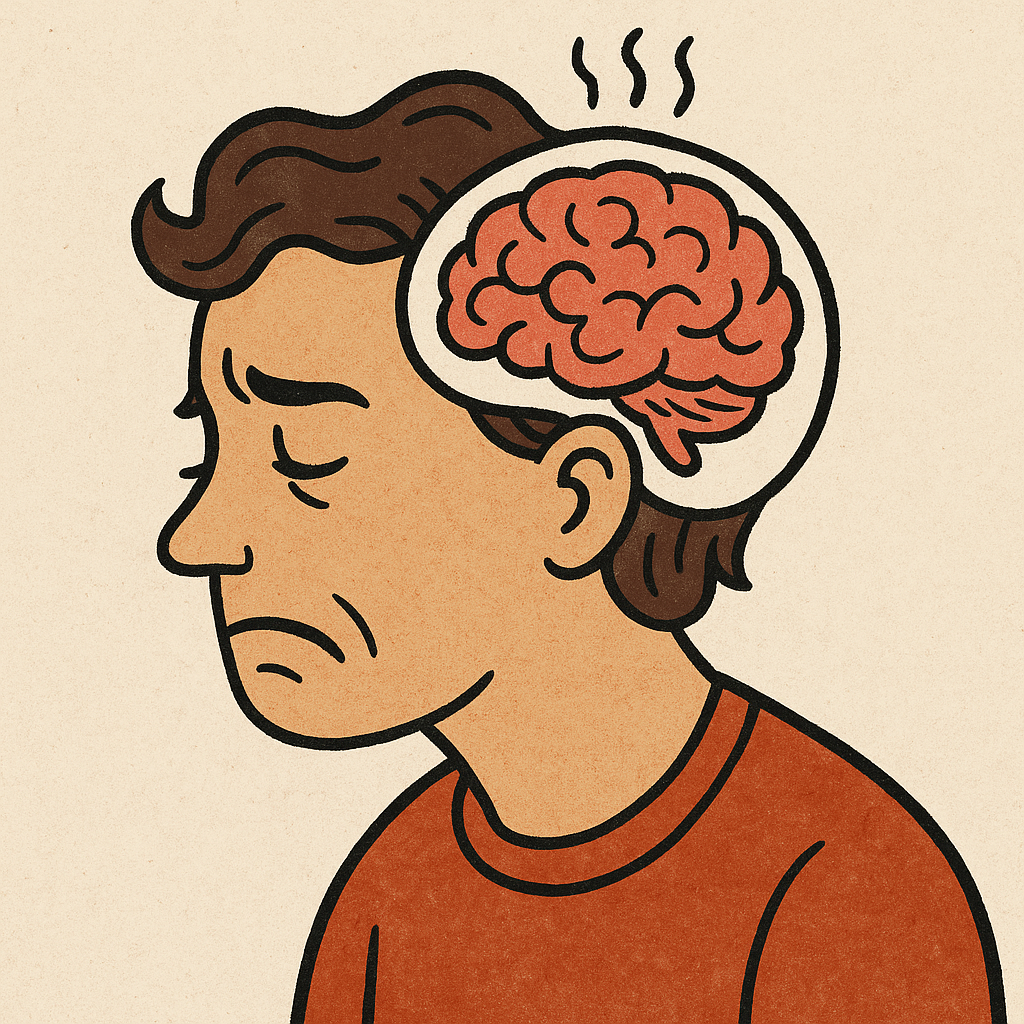
We hear a growling stomach. We miss a starving mind. Here’s how to notice the quiet signs and refuel without burning your life down.
There’s a simple honesty to the body. When it needs something, it makes a scene. Your stomach grumbles like a tiny thunderstorm. Your shoulders ache. Your eyelids stage a walkout. You don’t need a degree to decode it: eat, rest, move, drink water that didn’t come from a coffee bean.
The mind? Entirely different animal. It goes quiet when it’s underfed. No siren. No rumble. It just… slows. The edges blur; your thoughts turn heavy; your curiosity flattens out like soda left open overnight. That’s the trap: we are trained to respond to the body’s alarms and ignore the mind’s whispers. We feed one and starve the other, then wonder why days feel like we’re wading through wet cement.

You probably know the symptoms even if you haven’t named them. The hobby you loved now feels like homework. You scroll, not because you’re interested, but because it’s easier than feeling bored or lonely. You reread the same sentence three times and still couldn’t tell me what it said if I bribed you with a croissant. You show up to conversations with a polite smile and an empty cupboard where your attention should be.
And yet you keep going. Because you’re “busy.” Because rest still feels like something you have to earn. Because somewhere along the way, a lot of us learned that tired equals lazy and output equals worth. So we pour from an empty cup, then congratulate ourselves when nothing spills.
Here’s the uncomfortable truth: there’s a kind of exhaustion that sleep can’t fix. You can nap, you can crash for ten hours, and still wake up feeling like someone replaced your thoughts with damp cotton. That’s not a sleep problem. That’s a nutrition problem—mental nutrition. The mind needs a diet the way the body does: not just calories, but quality and cadence. Not just “content,” but nourishment.
It helps to think about mind fuel in three categories: stillness, beauty, and curiosity. Give yourself a working ratio—like a rough 1:1:1 plate—and your days change shape.
Stillness is the quiet you keep postponing. It’s a walk without a phone, the kettle boiling while you do nothing heroic, two minutes of watching your breath move in and out like waves that don’t need managing. Stillness isn’t glamorous, and it won’t impress anyone—but it returns your attention to you. Most of us are not actually short on time; we are short on unclaimed time. There’s a difference. Unclaimed time is where attention comes home, where your mind stretches like a cat in a sunny window and remembers it has a spine.
Beauty is medicine you forgot was legal. Light through leaves. A painting you don’t “get” but like anyway. A song that hits a bruise you didn’t realize you were carrying. Beauty recalibrates your nervous system faster than pep talks. It says, “Hey, there’s more here than schedules and inboxes.” And it does it without demanding anything back.
Curiosity is the mental protein. It’s the pursuit of a question simply because the question is delicious. Not content you consume while numbing out, but attention you invest because it makes you more alive. That might be a paragraph from a favorite book. A page of journaling that isn’t trying to fix you. A YouTube rabbit hole that teaches you how violins are made. Curiosity restores the sense that the world is bigger than your to-do list and that you, frankly, are too.

The tricky part is catching the hunger early, because the signals are soft. A few to watch for:
- You’re bored by everything and also too overstimulated to begin anything.
- Your sense of humor vanishes; everything gets “serious.”
- You start resenting tiny requests because your mental margin is already overdrawn.
- You forget nouns—basic ones. Fork? The stabby spoon?
- You keep checking for new notifications even though you know there aren’t any.
- You finish tasks and feel nothing. No spark, no relief—just the next task marching toward you like an unpaid bill.
None of that means you’re broken. It means you’re out of fuel. And just like actual hunger, mental hunger doesn’t care about your calendar. You can either feed it on purpose or it will turn you into a zombie who confuses activity with aliveness.
Let’s get practical. You are a human, not a monastery. You have obligations and people and deadlines. Fine. The solution isn’t to run away to a yurt (unless you’ve already bought the yurt, in which case, godspeed). The solution is to treat mental nourishment like basic hygiene and build it into the day you actually live.

One: Put stillness on the clock like a meeting you respect.
Two to five minutes at the top of each hour. That’s it. Stand, stretch, and breathe. Stare out a window. Not “meditation” with a capital M if that word makes you itchy—just deliberate non-doing. Set a timer if you must. The point is to stop the momentum long enough to notice the mind that’s been hauling your life around all morning like a pack mule.
Two: Replace some consumption with contact.
Consumption is what you do to pass time. Contact is what you do to feel time. Swap fifteen minutes of scrolling for fifteen minutes with something or someone you can touch—a book with a dog-eared page, your kid’s LEGO dragon, a skillet that sizzles onions into the air until the kitchen smells like comfort. The body is the front door to the mind. If your head is noisy, involve your hands.
Three: Give yourself a low-friction ritual at the start and end of the day.
Mornings: one page of anything—journal, poem, prayers, a messy list of what hurts and why. Even if you write “I don’t know what to write” ten times, you’ll feel the gears warm up. Even if you hate journaling, scribble a single sentence that starts with “Today, I want to feel…” and finish it without judging. Even if you lie to yourself, you’ll at least be in conversation.
Evenings: recap three moments you’re glad happened. Not gratitude as performance, but as practice: the decent coffee, the text that made you snort, the way the dog pretended to understand your rant. You’re stocking your mind’s pantry before sleep. Tomorrow’s you will thank you for not leaving it empty.
Four: Create a “soft feed” menu.
Think of this as your emergency kit for foggy days. You want options so easy your future, cranky self cannot refuse. Examples:
- A 20-minute playlist that makes you feel something (anything).
- A folder of short readings: poems, one-page essays, a paragraph from a book that never fails to loosen a knot in your chest.
- A list of tiny wonder prompts: “What has changed outside since yesterday?” “What color did I ignore all day?” “What’s the smallest thing I could fix right now that would make life 3% better?”
- A micro-walk route you can do without thinking—around the block, to the corner and back, down the stairwell and up again. No phone. Let boredom be a doorway instead of a dungeon.
Five: Institute a two-question check-in whenever you hit the slump.
- “Am I hungry, thirsty, cold, or overdue for the bathroom?”
- “What would make this 10% easier?”
You’d be astonished how often the mind’s fog lifts when the body’s basics are handled and the task is shaved down to a bite you can actually chew.
Six: Guard your margin like it’s money.
Because it is. Margin—the space between your capacity and your commitments—is what creativity, patience, and joy spend. Overbook that space and everything turns transactional. Build it in and people notice: your presence lands. You become the person in the room who hears the thing under the thing.
People sometimes push back here: “I don’t have time for this.” I get it. But the hours you lose to frictionless numbness are hours you’re already spending. The only question is whether you want a receipt. You can invest fifteen minutes in nourishment and get an hour of clarity back, or you can donate two hours to the algorithm and wake up with a headache and a vague sense that your life happened to someone else.

Another pushback: “Isn’t this just self-care?” Sure, but not the expensive kind with perfectly folded towels and scented adjectives. This is maintenance. You brush your teeth because the alternative is a dentist with bad news; you feed your mind because the alternative is a life that feels like a spreadsheet where the formulas stopped working.
If you need a single commitment to start, choose this: lower the volume before you raise the effort. Don’t force more willpower into a noisy head. Quiet the channel first. Close the extra tabs. Put the phone in the other room. Breathe like someone who expects oxygen to help. Then pick one soft thing and do it all the way. A walk without a soundtrack. A page without a goal. A song you actually listen to instead of letting it wallpaper your kitchen. Ten minutes later, see if the task that felt impossible has become merely annoying. That’s progress.
And please, stop assigning moral meaning to your fatigue. You are not lazy because your mind wants gentleness. You are not weak because you need quiet. You’re a human being with a nervous system, not a productivity appliance. There’s dignity in being a person who knows how to rest before they wreck.

Here’s what today could look like if you fed your mind on purpose:
You wake up and instead of lunging for your phone, you sit on the edge of the bed and ask, “How do I want to feel when I put my head back here tonight?” You make something hot and drink it while it’s still warm. You read a paragraph that nudges your brain into wakefulness the way sunlight nudges a window awake. You go for a five-minute walk—five—and listen to the weather. You come back and tackle the first necessary thing, not the noisiest thing.
At lunch you eat food that asks you to chew. Mid-afternoon, when the gray heaviness creeps in, you don’t scold yourself; you reduce the problem to the next true step and take it. Evening lands, and instead of scraping yourself across the finish line, you let beauty do the heavy lifting: a playlist, a shower that turns your skin back into skin, a single candle because you deserve mood lighting even on a Tuesday. You write down three things that were good. You turn off the light while you still like yourself.
You won’t nail it every day. That’s not the point. The point is to shift from starvation to feeding—deliberately, gently, repeatedly—until your baseline moves. Until curiosity wanders back like a stray cat that has finally decided you can be trusted. Until your sense of humor returns and you laugh at your own terrible joke. Until you’re no longer confusing speed with aliveness.
If you need a mantra, try this: My attention is a resource, not a reflex. I choose where it eats.
And if you need permission, here it is in writing: you don’t have to earn rest. You don’t have to break to take a break. You just have to notice the fog and decide to step out of it for a minute, even while the world keeps telling you that only the frantic are worthy.
Feed your mind something soft today. A short walk with your hands empty. A paragraph that reminds you you’re more than a task list. A song that stirs the dust. Let stillness, beauty, and curiosity do what they’ve always done for good humans in hard times: build a life from the inside out.
Moral takeaway: We live in a world that rewards exhaustion, not awareness. Choose awareness anyway. Choose a nourished mind over a frantic one. The work will still be there; you’ll just meet it with a self that’s awake.





Leave a Reply