
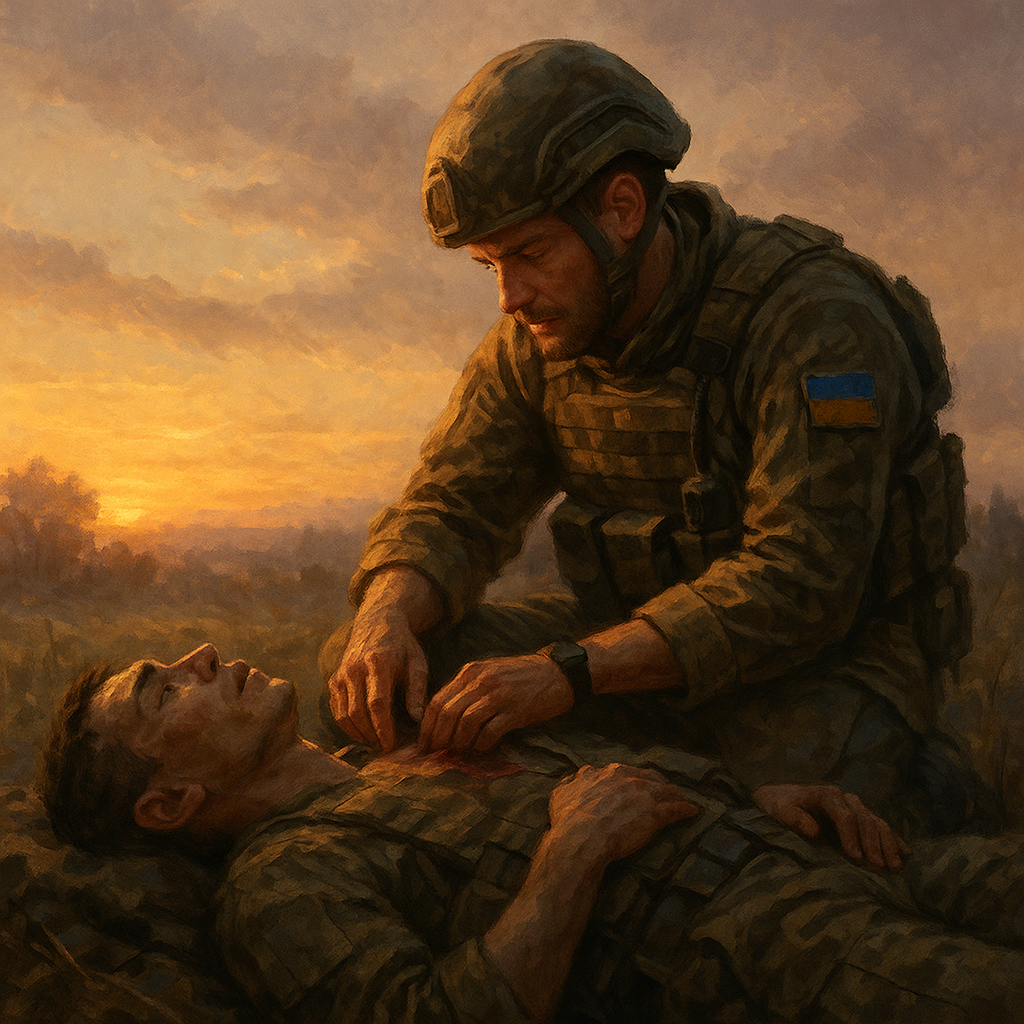
In a war that breaks so much, these medics remind the world that humanity still holds the line.
Just a few kilometers from Ukraine’s frontline, another kind of battle unfolds — not for territory, but for lives.
Here, in a repurposed basement near Kramatorsk, the stabilization point of the 5th Separate Kyiv Assault Brigade hums with quiet urgency. It’s the first stop for wounded soldiers pulled out of the chaos — Ukrainian, Russian, anyone who arrives bleeding and breathing.
This is where medics work in the half-light, steady hands against shaking walls, doing the impossible every day.

A War Zone Turned Trauma Center
Inside these makeshift corridors, every sound means something. A shout for plasma, the rattle of a stretcher, the unmistakable word no one wants to hear: “Wounded!”
The space is tight, sterile as it can be, but nothing about this work is routine.
When fighting flares, the stabilization point fills fast.
As Ivan, a red-haired nurse with the kind of smile that somehow survives the war, explained:
“We don’t ask where they’re from. If they’re wounded, they’re ours.”
It’s that simple.
There are no divisions here, no rival brigades, no “ours” versus “theirs.” There’s just damage and a duty to repair it.

The New Face of War Wounds
Modern war looks nothing like the old one.
These days, many of the injuries come from drones, not direct gunfire.
FPV drones now drop incendiary shells, leaving soldiers burned and broken in ways medics a few years ago couldn’t have imagined.
Ivan says burns and shrapnel are everywhere. Some fighters make it to the stabilization point within an hour — others wait days if evacuation is too dangerous.
“When the shelling is too heavy, we send supplies by drone — tourniquets, morphine, bandages. Their brothers do what they can until we can reach them,” Ivan explained.
It’s medicine by any means necessary.

The Biggest Enemy Isn’t Always the Bullet
Ask any field medic what kills most, and you’ll hear the same thing: blood loss.
By the time many reach the stabilization point, it’s a race against time.
“We see everything — amputations, head wounds, chest wounds,” Ivan said. “Blood is our most precious supply. Without it, everything stops.”
They rely on one type — O-negative, the universal donor. When it runs low, they send an emergency vehicle back to the hospital. The rest of the time, they just make do.
The team here can do nearly everything a hospital can — transfusions, intubations, X-rays, even resuscitations. Their goal: get each soldier stable enough for the next step — the hospital in Dnipro or further west.

The Moment Everything Stops
The calm never lasts.
Someone shouts. A stretcher slams through the door. The team moves instantly, no words needed.
This time it’s a young man, barely 23, blood soaked through the bandages on his neck.
They work on him right there — stopping the bleed, pumping plasma, restoring breath. Within minutes, he’s stable enough to move.
Ivan doesn’t linger on what happens next.
He just says, “He’s alive. That’s what matters.”

They Even Treat Their Enemies
There’s one moment that catches everyone off guard.
Sometimes, Ukrainian medics find themselves patching up Russian soldiers.
And they don’t hesitate.
Ivan put it plainly:
“You see the wound, you treat the wound. That’s the rule. We’re not animals.”
It’s not forgiveness — it’s professionalism. Humanity, even in the wreckage.

A Thin Line Between Compassion and Collapse
You can’t work in a place like this without learning to shut something off inside.
If you take every loss personally, you burn out fast.
Ivan admits that came with time.
“I learned that barrier in the hospital,” he said. “If I get too attached to one person, I can’t help the next. My job is to keep moving — as long as I can keep saving.”
For him, every life saved is its own kind of resistance. Every transfusion, a small rebellion against despair.

Why This Story Matters
It’s easy to forget, in a war full of numbers and explosions, that there are still people here holding the line for life itself.
These medics don’t fight for glory. They fight against time, blood loss, and exhaustion and they don’t ask whose flag a wounded soldier once carried.
In the middle of a brutal war, their work is proof that compassion isn’t weakness. It’s what separates the human from the inhuman.
As Ivan said before heading back to his shift:
“We’re not soldiers with guns. We’re soldiers with hands.”
And somehow, that feels like the truest kind of strength there is.



Leave a Reply