
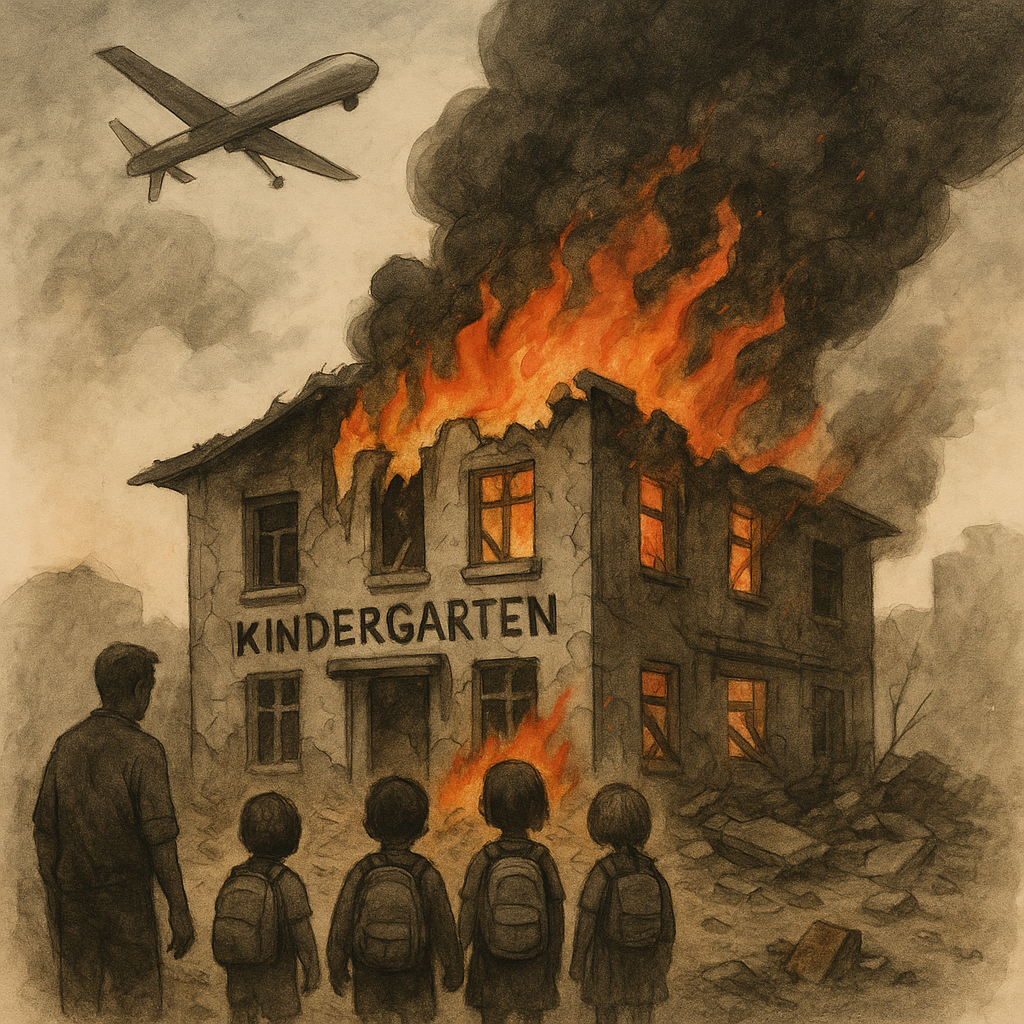
Russia’s line is that this was an “accident.” That’s what Kremlin envoy Kirill Dmitriev told CNN when pressed about a drone strike on a kindergarten in Kharkiv — that Russia doesn’t target kindergartens and “any casualty is a huge tragedy,” and that Moscow supposedly wants to end the war quickly.
I listened to that and felt the same cold anger every parent would.
Because the facts of October 22 aren’t ambiguous: a Shahed hit a school for toddlers, 48 children had to be rushed to shelter, a municipal worker was killed, and others — including a five-year-old girl — were injured.

You don’t call that an “accident” with a straight face. You call it what it is: a strike that set a children’s building on fire.
Here’s what we know — and what Russia’s spokesman tried to wish away. In the Kholodnohirskyi district of Kharkiv, three Shahed attack drones came in the morning.
One drone slammed into a private kindergarten, sparking fires that spread through roughly 500 square meters of the building. Staff moved nearly fifty kids into the basement in time; they lived because adults ran toward danger and did their jobs.
The Kharkiv Oblast Police and State Emergency Service released footage from the first minutes after impact — smoke, alarms, kids crying, firefighters moving them out. The death toll for the city that day included a man working outside; the injured list included a child.
That’s not narrative. That’s a police log.
And yet on CNN, Dmitriev said Russia does not target kindergartens — “ask the military” about the specifics — and then fell back on the word “accidents.” If this were a one-off in a war otherwise scrupulous about civilian safety, maybe you could argue misfortune.
But this sits inside a well-documented pattern: civilian infrastructure and schools repeatedly hit by loitering munitions and drones across multiple cities. You can hear the euphemisms working overtime — “tragic accidents,” “not our intent,” “end the conflict quickly.”
That isn’t accountability; that’s public relations.
Key facts, no spin:
- Date/Place: Oct. 22, Kharkiv (Kholodnohirskyi district).
- Weapon: Shahed (Iranian-made) loitering munition used by Russia.
- Children: 48 were in the building; all evacuated to shelter and survived.
- Casualties: 1 adult killed, 10 injured overall in Kharkiv; among the wounded, a five-year-old girl.
- Damage: Fires inside the kindergarten; extensive interior burn area reported.
- Official narrative: Kremlin envoy on CNN: “Russia does not target kindergartens… many tragic accidents.”
I’m a dad. I can’t write about this like it’s just another data point. These are kids. The word “accident” does heavy lifting when you’ve got a drone flight path, a camera on the nose, and a building labelled for children.
When missiles and drones hit apartment blocks, clinics, and schools, you’re not watching fog-of-war mishaps; you’re watching a strategy of pressure that treats civilian terror as leverage. Call it what you want in a studio — out here, parents are carrying toddlers through smoke.
The Kremlin’s message discipline can’t hide the footage. Ukrainian police and emergency services have put out videos from the first minutes after the strike. Independent outlets logged the casualty numbers and confirmed the location.
And yes, the war is full of tragedy but tragedy doesn’t absolve targeteers and launch orders. The burden is on the side flying the drones to not hit a kindergarten. If you keep hitting them — and then call it an accident — that’s not exculpation; that’s an admission you won’t change the behavior.
I’ll end where this started: 48 kids made it home because teachers and firefighters ran into a burning school. One man didn’t. Ten people are hurt. A child is on that list. You don’t rationalize that away with the word “accident.” You fix the conduct that makes it possible.
Until then, the only honest label is civilian targeting and the entire world can see it.




Leave a Reply