
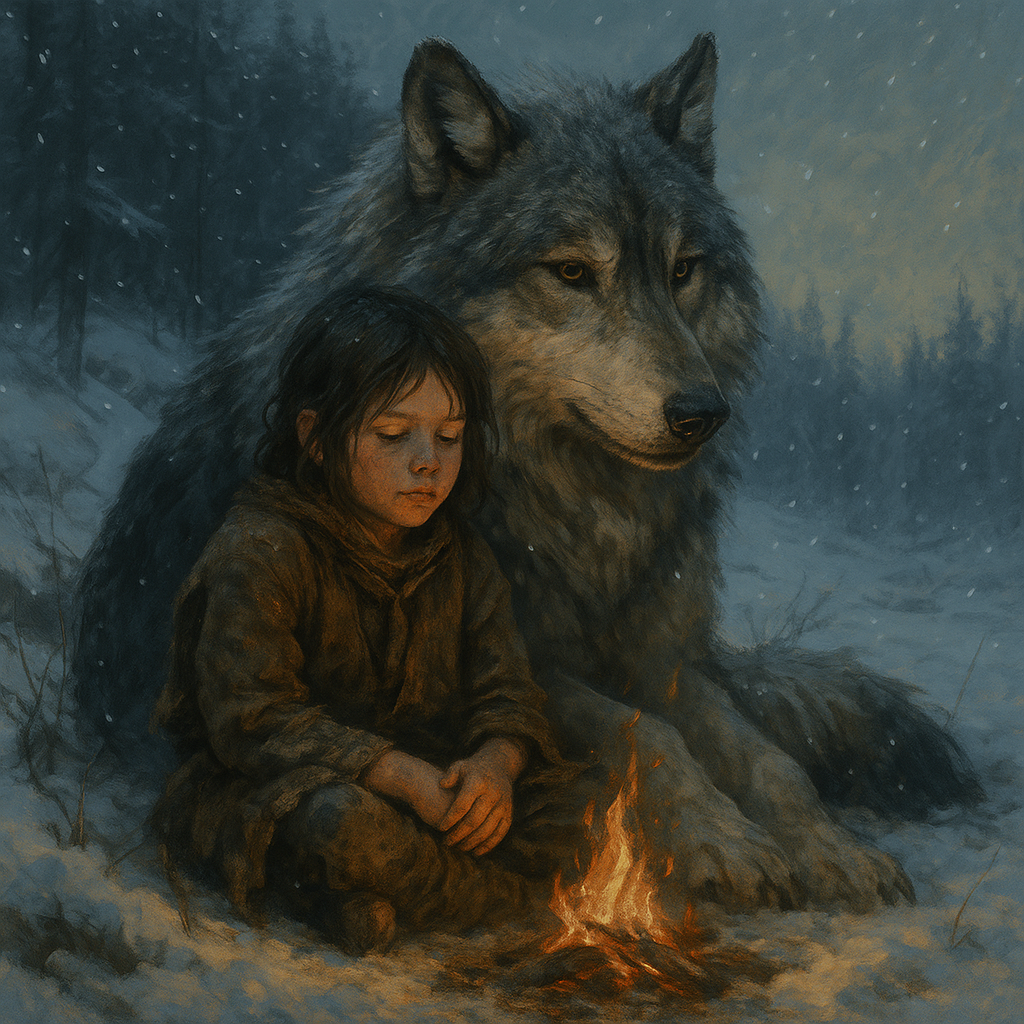
Snow takes the sound out of the world. It lays a quiet hand over the trees and the stones and the ribs of the earth until even the wind forgets its teeth. In that hush a boy lies where someone left him—blanket stiff with frost, breath a thin thread that snags and frays in the cold. He is small the way beginnings are small. His lips are cracked. His eyes are open.
The wolf finds him by the wreck of a scent: milk and smoke and iron fear. She pads from shadow to shadow, heavier than legends say, a mountain of muscle wrapped in winter, a dire thing whose paws make no apology. Her breath ghosts in the air as she lowers her head. The boy’s gaze flinches, then steadies, and in the flat brown of his eyes the wolf sees something that is not prey.
She circles once. Twice. The old laws say take the weak because the winter takes everything else. The older law—older than teeth—says keep what the winter cannot have.
The wolf noses the blanket. The boy startles, a dry rustle in a world of white, and lifts a hand so slow it seems like a choice he could still refuse. His fingers rest on the wolf’s muzzle. Her whiskers twitch. She does not bite.
Night comes on like a door closing. The wolf drags him by the cloth, careful not to break skin. It is an awkward mercy, the way she pulls and pauses, pulls and pauses, stopping to listen to the boy’s rattled breathing. When the moon thins to a hook, she has him tucked in the roots of a black spruce where the wind cannot reach. She curls around him, rib to spine, and lends him the heat she would have given her cubs if the river hadn’t taken them.
At first light, the boy tries to die—because that is what happens when the body runs out of arguing. But death is a poor listener when a wolf is speaking. She licks his face until warmth wakes him angry. She drops a half-frozen hare beside his hands and watches as clumsy hunger figures out how to live.
Days are a string the forest threads. The boy learns the wolf’s language: ear tilt for yes, tail-level for no, the chuff that means stay low, the rumble that means don’t. He learns snow’s moods and the way crows give sermons no one asked for. He learns to breathe through silence, to step where the wolf steps, to trade his name—for now—for the small honest names of things: pine, creek, star, wound.
He grows taller by inches saved from cold and hunger. His hair tangles like twigs. His hands go brown with bark and winter sun. He laughs once, the sound startling both of them, because a mink slips and scolds itself. The wolf flicks an ear, as if humor is a prey neither of them expected to catch.
They find antler sheds, and he makes a hook. He learns to set snares that do not sing when they close. He learns to sleep with one hand open, palm to fur, a covenant of warmth. In the high dark, the wolves of other packs sing the map of their distance. His wolf does not answer. She has made a different circle: boy and tree and snow and the work of being alive.
Sometimes they follow old tracks down to the river. Ice groans under them like an old man getting out of a chair. The wolf tests each step; the boy mirrors her, gaze on the way her weight speaks to the world. On the far bank, a stag lifts its crown and draws them in the eyes: I see you. The wolf does not chase. The boy does not ask why. There are questions you only have to learn once.
When spring unties the knots in the streams, the forest breathes out. Green returns stubbornly, leaf by leaf. The boy’s knees collect scars from running where he should have walked. He finds wild onion and garlic and tastes sunlight in the bulbs. The wolf catches fish by lunging into the melt, comes up laughing water, and the boy claps like storms.
A season turns. Then another. He is no longer small. He moves like he belongs to the ground, because he does. The wolf’s muzzle frosts with age. The black along her back goes pepper-gray. She hunts less and watches more, as if guarding a fire he can’t see.
The day trouble comes, the forest announces it long before steel appears. Jays flare and curse. Rabbits stop being anything but the idea of gone. The boy and the wolf are high on the ridge, tasting the wind. Smoke rides it—thin, dry, and wrong. People-smoke.
They see the man first, then his idea of himself. He is leather and iron and a cloak the color of the forgiving kind of blood. He moves with the care of someone who has met winter and learned politeness. A spear rides his shoulder like an accusation. He pauses when he sees them, eyes narrowing to weigh and measure.
To him, the picture is simple: a monster and the feral child it kept. A story that ends with a spear to clean the world.
The wolf rises slow, old bones keeping old dignity. The boy steps forward and the old laws wake up, cold and sharp. The man lowers the spear point.
“This one,” the boy says, voice rough from not using it for anything but quiet, “is not for killing.”
The man’s mouth twitches like the idea of a smile that forgot its lines. “Son,” he says, the word trying to claim him, “that is a wolf.”
“I know,” the boy says, and in the way he says it there’s a prayer and a promise and the whole winter.
They stand there, three truths on a ridge. The spear is impatient. The wind is busy. The wolf sits because dignity doesn’t do arguments with steel.
“Step aside,” the man says, not unkindly.
The boy steps in front of the wolf.
The forest holds its breath the way it did the day she found him. A jay forgets itself and scolds. The man’s shoulders soften, just a fraction. It is enough for a different ending to try itself.
“I have bread,” the man offers, like a treaty the world might accept. “Come down with me. Sleep under a roof. The monster dies, the story gets better.”
The boy looks at the spear, then at the hands holding it, then at the wolf who taught him how to stay when everything else leaves. He shakes his head. “Some stories get better because nobody dies in them.”
The man is not cruel. He is tired. He has a village behind him, and a child who wakes at night and cries because the old tales have teeth. He wants a clean world with no dark edges at its fences. He wants to save someone today.
The wolf leans into the boy’s leg, heavy and warm. She is not asking him to fight. She never has. She is asking him to stand.
He plants his feet. He lowers his hands. He becomes a door the spear will have to open if it wants to pass.
Something in the man recognizes something in the boy, like a mirror lit by lightning. He exhales. The spear point drops until it points at dirt. He studies the wolf’s eyes and finds no hunger there that wants him. Only the shoreless patience of a creature who has already lost enough.
“Keep her out of the lambing fields,” he says at last. “Teach her that fence means turn.” A shrug. “Teach yourself.”
“I already have,” the boy says.
The man nods once, as if they’ve traded names without saying them, and turns away. His footsteps ask the ground for permission. The ground allows it.
The ridge remembers how to breathe. The wolf folds herself down with the care old bodies require. The boy sits beside her and scratches the gray along her ear. For a while they are only the fact of each other, which has always been enough. Clouds move shadows across them like the hands of a gigantic clock that tells nobody what time it is.
Summer climbs, then descends, and with it the wolf’s strength. She eats less. She dreams more. On the last evening, when the sun pretends it will never leave again, she lays her great head in his lap like she did the first night, when the roots were a fortress and his breath was an argument with cold. He strokes her fur until his hand learns stillness. She breathes in, out, in—and keeps the out.
He does not cry. The snow does that later, in its season, on his behalf.
If you ask the old men in the hill villages, they will tell you, when the fire settles low and the wolves are only voices far away, of a winter when a monster spared a child and the child repaid the debt by letting the world be gentler than it had to be. They will shrug and say the boy learned fences and the wolf learned peace, or maybe the other way around. They’ll add, because people like their endings tidy, that the lambing went fine that year.
And if you go to the ridge when the first snow falls and listen hard, you may hear nothing at all—only the quiet hand the season lays over teeth and stone and ribs. But some swear they’ve seen a young man pass that way with a gray shadow keeping pace at the edge of his steps, and they’ll tell you, soft as if not to wake the story, that even monsters crave peace, and sometimes the world lets them have it.




Leave a Reply