
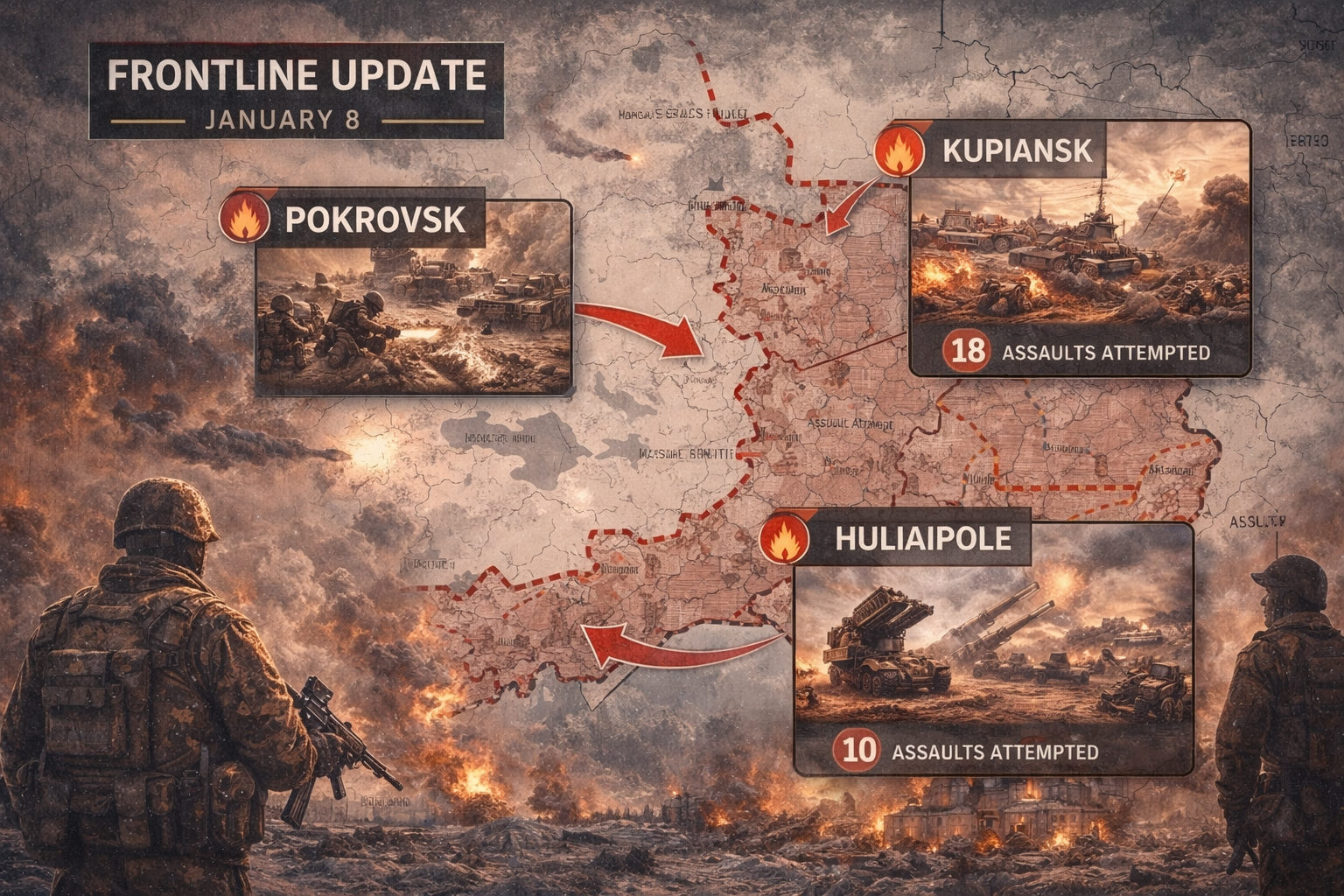
By mid-afternoon on January 8, Ukraine’s General Staff logged 54 combat engagements across the front. On paper, that sounds like just another day in a long war. In reality, it tells a very specific story about where Russia is pushing, where it’s stalling, and where the strain is starting to show.
If you zoom out from the individual village names and look at the pattern, one thing becomes clear: Russia is concentrating effort, not achieving momentum.
Let’s walk through what’s happening, direction by direction, and why it matters.
The Border Pressure: Sumy and the North
In the Sumy region, Russian artillery continued to harass border settlements like Kucherivka, Studenok, Bila Bereza, and Ryzhivka. This isn’t about territorial gain. It’s about keeping pressure on Ukraine’s border communities and forcing Kyiv to keep units tied down away from hotter fronts.
Artillery fire here serves three purposes:
- Disruption of civilian life
- Forcing Ukraine to allocate air defense and counter-battery resources
- Maintaining the appearance of “activity” without committing maneuver forces
This is cheap pressure, and Russia leans on it heavily when breakthroughs elsewhere don’t materialize.
Northern-Slobozhanskyi and Kursk: Noise Without Movement
In the Northern-Slobozhanskyi and Kursk directions, Ukrainian forces repelled two assaults. Russia also carried out 51 strikes across positions and settlements, including one MLRS attack.
That ratio matters.
Lots of fire, very little movement. This is Russia burning ammunition to keep pressure up, not opening new operational space. It’s harassment warfare, not maneuver warfare.
Kupiansk: The Deadline That Keeps Slipping
Kupiansk deserves special attention, because it keeps coming up in Russian rhetoric.
The Kremlin has set February 2026 as the new deadline to “recapture” the city. This isn’t the first deadline. It likely won’t be the last.
On January 8, Russia managed exactly one unsuccessful attempt toward Kupiansk.
That gap between rhetoric and reality matters. Kupiansk is important because it’s a logistics hub, but the terrain, Ukrainian defenses, and Russian force quality have repeatedly turned it into a grind rather than a breakthrough opportunity.
Deadlines don’t win wars. Logistics and manpower do. So far, Russia has struggled with both here.
Lyman: Pressure Without Payoff
In the Lyman direction, three attacks targeted Drobyshcheve and Stavky. Two were still ongoing at the time of reporting.
This area continues to absorb Russian assaults because it offers potential access routes deeper into Donetsk. The problem is that Ukrainian defenses here are layered, experienced, and well-supported.
Lyman remains a place where Russia tries often and succeeds rarely.
Kramatorsk and Sloviansk: Notably Quiet
No Russian offensive actions were recorded in the Sloviansk and Kramatorsk directions.
That silence matters.
These cities are politically symbolic and militarily significant. The absence of attacks suggests Russia lacks either the forces or the confidence to escalate here right now. When Russia goes quiet in key sectors, it’s usually because resources are being pulled elsewhere.
Kostiantynivka: The Grinding Middle
Eight assaults hit villages like Oleksandro-Shultyne, Pleshchiivka, and Ivanopillia. This is classic attritional pressure.
Russia keeps probing here because a collapse would open routes toward larger urban centers. Ukraine keeps holding because these are exactly the kinds of advances that snowball if left unchecked.
This sector is not dramatic, but it’s exhausting. For both sides.
Pokrovsk: The Hottest Ground Right Now
If there’s one place to watch, it’s Pokrovsk.
Russia launched 18 assault attempts in this direction. Ukraine repelled 16 of them.
That’s not accidental.
Pokrovsk sits on critical logistics routes feeding Ukrainian defenses across Donetsk. Russia wants to degrade those routes. Ukraine knows it, and that’s why defenses here are dense, disciplined, and reinforced.
High assault numbers paired with high failure rates usually indicate:
- High Russian casualties
- Declining unit cohesion
- Pressure from higher command to “do something”
This is where Russia is bleeding for inches.
Oleksandrivka and Huliaipole: Persistent Friction
In Oleksandrivka, Russian forces advanced in several villages but were largely stalled, with multiple engagements still ongoing.
In Huliaipole, 10 clashes took place, with airstrikes hitting nearby settlements. This combination of ground probes and air attacks is meant to stretch Ukrainian defenses and test response times.
It’s pressure warfare, not breakthrough warfare.
The Prydniprovskyi Direction: Symbolic but Limited
A single unsuccessful assault near the Antonivskyi Bridge was recorded.
This area remains strategically sensitive because of river crossings, but Russia has shown little capacity to translate symbolic pressure into sustained movement here.
What This All Adds Up To
Taken together, January 8 looks like this:
- Russia is active, not advancing
- Assault numbers are high where stakes are high
- Breakthroughs are absent
- Deadlines are being announced to mask slow progress
This is a war of pressure, not momentum.
Russia is trying to force outcomes through repetition and exhaustion. Ukraine is responding with defense, denial, and selective counter-pressure.
Nothing here suggests collapse on either side. But it does show where the war is being decided inch by inch, not headline by headline.
The front is alive. It’s just not moving the way Moscow wants.




Leave a Reply