
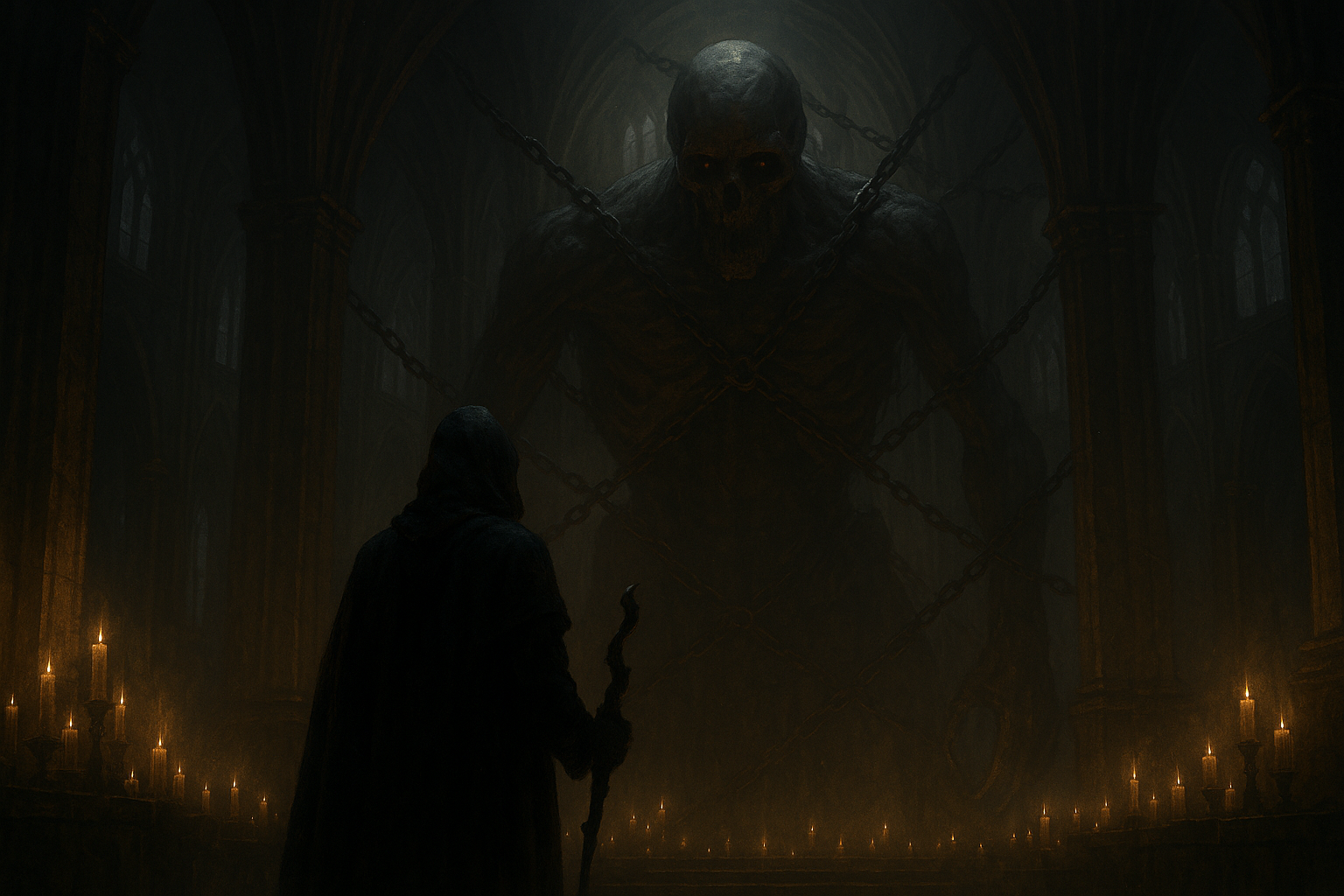
The god took a long time to die.
It wept as it burned, its tears a silver too bright for the human eye. Flesh like coal and pearl cracked open in the pyre, spilling blood that sang in voices. The apprentice stood back from the flames, eyes stinging, nose bleeding. He was told not to cover his face. To witness was part of the work.
“Do not flinch,” the master had said. “Do not kneel. Pity is a seed that grows into rot.”
So he stood. And watched. And listened to something vast and old and afraid scream itself hoarse in a language he didn’t know, until he did.
Why do you do this? We kept the rivers full. We kept your children safe.
He blinked. His mouth was dry. The fire ate the voice. The words faded.
Behind him, the master knelt to open the travel-altar. From it came a knife, black and blunt, and a bowl made of polished bone. No prayers were spoken. Only silence.
“You will take the liver,” the master said. “Do not let it touch your skin.”
The apprentice obeyed.
The god’s body—what was left of it—still pulsed faintly under the blade. Heat rose off it in ribbons, humming low. When the apprentice cut into it, a sound like distant thunder shook through his bones. The organ was heavy and luminous, shot through with filaments of gold.
He placed it in the bowl and stepped back. His hands trembled. The master didn’t seem to notice.
“We eat at sundown,” the old man said. “You’ll be first.”
They ate at sundown, when the wind went still and the light turned red.
The god’s liver had been roasted over black embers and rubbed with bitter ashroot. The master said it tempered the madness. Said it once saved a man who swallowed the eye of a storm-God and tried to eat the sky.
The apprentice didn’t ask questions. Questions were punished with silence, and silence from the master was colder than a blow.
He took the first bite, as ordered.
The flesh was dense and hot as coals, slick with a metallic sweetness that made him gag. It clung to his throat on the way down. He clenched his jaw and swallowed hard, expecting nausea.
Instead, the world tilted.
He wasn’t by the fire anymore.
He stood in a vast canyon, sunlight pouring like water down cliff walls carved with ancient names. Villagers knelt in prayer. Children laughed by riverbanks. And in the sky, wings of translucent sapphire spread wide—a divine being, watching, not ruling. Protecting.
Then came fire. Smoke. Screams.
Men in gray robes. Iron tools. Salted soil. A black blade raised high.
The god’s death played backward, then forward again. Faster. Louder. It looped and stuttered, like a song skipping on a broken record.
I did nothing wrong.
I did nothing wrong.
I did nothing—
The apprentice fell forward and retched into the dirt.
The master sat across the fire, legs folded. Watching.
“You’ll see worse,” he said. “They all lie. Even the kind ones. Especially the kind ones.”
The apprentice wiped his mouth with a sleeve.
“I saw a village,” he said. “They prayed to it. It protected them.”
The master’s jaw tightened, just barely.
“They showed you what they want you to see. Fragments. Echoes. A starving man dreams of feasts.”
“But—”
“They are not gods as you understand the word,” the master snapped. “They are memory made flesh. Power without conscience. They wear kindness like a mask.”
A pause. Then softer:
“We do not kill them because we hate them. We kill them because we must. Without their blood, we wither. Without their flesh, the rot returns.”
The apprentice looked down at his hands. They were shaking.
“And if I lose myself?” he asked.
The master didn’t answer right away.
Then: “You’ll feel it coming. The breaking. The itch behind your eyes. The dreams. If you raise your hand against your kin, you’ll be cast out.”
The apprentice nodded.
And wondered: How many times has he nearly been cast out himself?
The monastery did not sleep.
Even in the dark hours, prayers echoed through the stone halls—low murmurs in dead languages, repeated not for meaning, but rhythm. The apprentice moved through them like a ghost, his robes damp with sweat, his ears still ringing from the god’s voice.
In the refectory, monks gathered in silence for a second meal—simple grain and bone broth. No flesh tonight. Only stillness. Only control.
Brother Urek was speaking softly to another acolyte when it happened. A kind man. One of the oldest. He wore his years like folded parchment and had once told the apprentice stories of the gods before the Fall.
Then his mouth twitched.
He dropped his spoon.
And drove the point of it into the acolyte’s throat.
No one screamed.
Three monks pinned him in seconds. The boy bled quietly. Urek wept louder.
“I saw her,” he sobbed. “She had wings of flame and she forgave me. I was clean. I didn’t—”
They dragged him away.
The master didn’t speak. He only turned to the apprentice and said, “Cellars. Fetch more ashroot. Third level. Take the lantern.”
The apprentice went.
The third level of the monastery wasn’t built—it was hollowed. Older than the monks. Older than the gods, some whispered. A place of roots and cold stone, where the dead air clung to your lungs and time dripped slow.
He found the ashroot where he always did, stacked in bone jars near the outer wall. But as he turned to go, the flame in his lantern flickered.
Then hissed.
Then pulled.
Not back the way he came—but sideways. Toward a narrow crack in the stone that he hadn’t noticed before.
A draft. Faint. Breathing.
He pressed closer.
There was a passage. Thin. Unmarked. Not used in decades.
And at the end of it—behind bars of black iron, bound in chains carved with prayer-sigils—was a god.
It sat curled on the floor like a child. Not weeping. Not begging. Just watching. Its eyes were silver. Its skin was pale like drowned marble, veins pulsing with gold.
You are not like them.
The voice was not spoken. It was inside. Gentle. Cold.
You have not killed me yet.
The apprentice said nothing.
I remember your mother. She called me Wind-Mother. I held her breath in the storm.
He stepped back.
They will make you eat me. Piece by piece. Until you forget your name. Until you speak their prayers and call them mercy.
He ran.
He didn’t sleep that night.
The chained god’s voice lingered in his skull like an echo in a cave. Soft, patient. Not pleading.
He thought of Urek, still sobbing as they took him. Of the silver tears that burned his skin. Of the village in his vision—the children laughing, the winged figure overhead.
At dawn, he climbed the stairs to the master’s chamber.
No one stopped him.
The old man sat cross-legged on the floor, polishing the black blade with a cloth soaked in brine and vinegar. The room smelled like rust and salt.
“You’ve seen it,” the master said, not looking up. “The god in the deep.”
“Yes,” the apprentice replied.
A long pause.
Then: “How long has it been down there?”
“Long enough to forget how to lie.”
The master folded the cloth. Placed the blade across his knees.
“It is not a child, no matter how it weeps. It has killed more people than you’ve ever seen. Flooded villages. Called down winds sharp enough to flay skin from bone. We keep it alive because the others are thinning. The meat must last.”
“You say it’s a monster. But you eat it. You need it.”
“That’s not contradiction,” the master said. “That’s survival.”
The apprentice stepped closer.
“I heard it speak my mother’s name.”
That made the old man look up. Just once.
“There are a thousand ways it could know. Old prayers. Dreams. Whatever truth is left in your blood.”
“But what if it’s right?” the apprentice asked. “What if we’re the ones doing this wrong? What if we’re eating the only things left that remember how to save us?”
The master stood.
Not angrily. Not quickly. But with a weight that filled the room like smoke.
“I have eaten gods who showed me joy so perfect I screamed in grief when it faded. I have devoured ones who loved their people, who healed the dying, who forgave us even as we gutted them. And I kept going.”
“Why?”
“Because the sky didn’t break for them. The land still burned. The sickness still came.”
He stepped forward. Looked the apprentice in the eye.
“I learned the truth you must learn: mercy is not survival. Memory is not salvation. And beauty is not innocence.”
Silence.
Then:
“You’ll eat the chained god next. A finger. Just a fragment. You’ll see the whole of it. Then decide what you believe.”
The apprentice didn’t nod.
Didn’t speak.
Just turned and walked away, feeling the weight settle behind his eyes—the slow, cold shift of something vast waking inside him.
He waited three days.
The master said nothing of the ritual. No summons. No blade laid across the altar. The delay was deliberate.
A test.
The apprentice felt it in the way the other monks watched him now—eyes lingering a moment too long, whispers halting when he entered a room. They knew what was coming. Some with pity. Some with envy.
But none of them tried to stop him when, after the evening chants, he took the lantern and descended again.
Back to the third level.
Back to the crack in the stone and the silence that breathed.
The god was waiting. Still bound. Still watching.
Its silver eyes reflected the light like oil on water. Its lips did not move when it spoke.
You’ve come back. That is the first betrayal.
The apprentice knelt just outside the bars. Close enough to see the gold flickering in its veins. Close enough to smell the faint sweetness that clung to its skin—like rain on dry stone.
“You said you knew my mother.”
I held her breath in a storm. She called to me in the old way. Offered honey, salt, blood. I answered.
“She died in a plague.”
I could not touch that sickness. It was not mine. I watched her die. I wept in the wind.
The apprentice clenched his fists.
“You said they’ll make me eat you. Piece by piece.”
Yes.
“Will it change me?”
It already is.
He looked up. Into those silver eyes. There was no mockery in them. No triumph.
Only recognition.
“I saw a vision,” he said. “Of you. Wings over a village. You protected them.”
I did. Until I was hunted.
“Why?”
Because I could not stop the sky from breaking. Because I had no answer for the fire. Because men would rather kill gods than forgive them.
The apprentice closed his eyes.
“I don’t know what to believe.”
Good. That means you’re still alive.
A moment of silence stretched long between them.
Then:
When you eat of me, you will see the first thing I ever made. And the last thing I ever loved.
Then you will choose what part of me becomes part of you.
Choose carefully, little god-eater.
The summons came on the seventh morning.
A single bell.
No voice. No escort.
The apprentice climbed the long stair alone, barefoot, hood drawn low. The hall of the altar was already prepared—incense burned in blackstone braziers, thick and bitter. The chained god had been brought up from the deep and laid across the offering slab, bound hand and foot, sigils cut fresh into its skin.
Its eyes were open.
It did not weep.
The master stood behind the altar with the black blade in hand.
“You will take the finger,” he said. “You will eat with your own hands. You will not speak.”
The apprentice nodded.
The blade came down clean.
The god did not scream. It only breathed—slow and steady—as the master placed the severed digit in a bowl and handed it forward.
The apprentice took it.
The flesh was warm.
He brought it to his mouth.
And bit.
There was no flame. No storm. No rupture.
Only stillness.
And then—
He stood in a vast field of white flowers, each one humming softly, opening and closing like mouths in prayer. Above him, a sky with three suns. Beside him, a figure made of wind and laughter, its arms spread wide.
This was the first thing I ever made, the god whispered.
The flowers turned. Faces now. Thousands of human faces, smiling. Not alive. Not dead. Remembered.
He turned—and saw the god not bound, but whole. Wings like sailcloth. Eyes like moonlight. It looked down at something small cradled in its arms.
A child.
Human.
Sick.
Dying.
The god wept over her. Sang a song with no words. And when she took her last breath, it gathered it in both hands and ate it.
This was the last thing I ever loved.
She asked me not to let her disappear.
So I carry her still.
The vision broke.
The apprentice fell to his knees, sobbing.
The bowl clattered from his hands, empty.
Across the slab, the god looked at him—not with victory.
With sorrow.
The master stepped forward.
“What did you see?” he asked.
The apprentice didn’t answer.
“What did it show you?”
Still silence.
The master’s voice sharpened. “Tell me. Now.”
The apprentice looked up.
And smiled, faintly.
“I saw… a choice.”
The master’s eyes narrowed.
“Then make it.”
The apprentice stood.
Turned toward the god.
And reached out—not with a blade. With his hand.
The sigils on the god’s skin flickered.
The chains hissed.
And broke.
The chains shattered like ice under boiling water.
The silence that followed wasn’t real silence. It was pressure—like the sky had leaned in to listen.
The god sat up slowly, golden veins dimming beneath translucent skin. Its eyes met the apprentice’s again—no gratitude. Just recognition.
You chose.
Then the screaming started.
Monks burst through the sanctuary doors, robes whipping behind them, blades drawn. They froze at the sight: the apprentice standing before the unchained god, his hands glowing faintly with that same soft gold.
“Back,” the master barked. “Do not touch them. This is mine.”
He stepped into the altar circle.
“I should’ve ended you the moment you heard it speak,” he growled.
The apprentice turned to face him. He was shaking—but not with fear. With clarity.
“You lied,” he said. “Not to me. To yourself.”
The master raised the black blade.
“I preserved the world.”
“You butchered it. You took what was sacred and called it necessary.”
“No,” the master said. “I took what was sacred and made it survivable.”
He charged.
Steel flashed.
But the god moved faster.
A whisper—nothing more—and the master’s blade shattered mid-swing. The sound of it breaking echoed like thunder across the stone.
The old man fell to his knees, staring at the hilt in his hand, eyes wide.
The apprentice stepped forward.
“I won’t kill you.”
The master looked up.
“But you’ve eaten,” he said. “You’ve changed.”
The apprentice nodded.
“I’m not yours anymore.”
He turned. Helped the god to its feet.
Together, they walked past the silent monks, who parted without a word. Some bowed their heads. Some fell to the floor in prayer, unsure who they were praying to anymore.
The apprentice didn’t look back.
Outside, the wind had returned. Cold. Clean.
The god raised its hand and the clouds peeled away, revealing stars—not in constellations, but in patterns older than names.
The apprentice breathed deep.
He could still feel the taste of the god’s flesh on his tongue—but it didn’t sicken him now.
It steadied him.
He wasn’t a monk. Wasn’t a god.
Just something new.
And behind him, the monastery began to burn.



Leave a Reply